
Jebel Ali Steel Supplier: Why Location Wins
If your steel supplier is not based at or near Jebel Ali, you are paying for that gap every time a project deadline tightens. Procurement managers at construction companies and fabrication firms across the UAE and GCC have learned this the hard way: a two-day customs delay or a partial stockout at an inland yard can push a project into penalty territory. Choosing a Jebel Ali steel supplier is not a preference, it is a supply chain decision with measurable consequences for cost, lead time, and product availability. This article lays out exactly why the location of your steel stockist matters, and why the Jebel Ali Free Zone ecosystem consistently outperforms every alternative for structural steel distribution across the GCC.
Table of Contents
Quick Takeaways
Key Insight
Explanation
Port-adjacent replenishment cuts wait times
Jebel Ali stockholders can replenish inventory directly from inbound vessels, avoiding the secondary inland transport step that delays other distributors.
JAFZA zero-duty re-export structure reduces landed cost
Goods imported and re-exported within JAFZA attract zero customs duty. The 5% import tariff only applies when steel crosses into the UAE mainland, giving GCC-bound orders a direct cost advantage.
Jebel Ali Port connects to 150-plus global ports
This connectivity means frequent vessel calls from major steel-producing nations, shortening the replenishment cycle for structural steel products compared to smaller UAE ports.
Digital customs via Mirsal 2 enables same-day clearance
Dubai Customs' Mirsal 2 platform integrates directly with JAFZA operations, allowing documentation for GCC-bound steel shipments to be processed the same day loading is confirmed.
Direct overland corridors to Saudi Arabia, Oman, and Qatar
Heavy-haulage routes run from Jebel Ali via the Hatta border crossing and established GCC road corridors, making it the most efficient single dispatch point for multi-country orders.
JAFZA's metal and steel cluster is valued at AED 26.7 billion
Over 1,000 companies from 89 countries operate in JAFZA's Metal, Steel and Construction cluster, creating a deep supplier and services ecosystem that benefits every tenant.
Port-adjacent suppliers carry broader product ranges
Because replenishment logistics are simpler at Jebel Ali, stockholders there typically maintain wider product ranges, enabling single-source fulfillment for complex multi-product orders.
Why Jebel Ali Is Not Just Another Port
Most people know Jebel Ali as a major port. What fewer appreciate is the specific combination of port scale, free zone fiscal structure, and road infrastructure that makes it genuinely different for steel supply chains, not merely larger.
Jebel Ali Port, managed by DP World, holds an annual container handling capacity of approximately 19.4 million TEUs across four terminals. In 2024, the port processed 15.5 million TEUs, its highest volume since 2015. More relevant to steel procurement: the port also recorded a 23 percent year-on-year rise in breakbulk cargo, reaching 5.4 million metric tonnes. Breakbulk is how structural steel moves. That growth reflects rising infrastructure and industrial investment across the region, and it is concentrated at Jebel Ali for a reason.
The port connects to over 150 global ports, with frequent direct vessel calls from steel-producing regions including Asia and the Indian Subcontinent. For a stockholder like Alpine Metals, this means inbound mill shipments arrive on predictable, high-frequency schedules rather than the sporadic rotations that smaller UAE ports experience. Predictable arrivals translate to predictable inventory, and predictable inventory is what construction project managers actually need.


Jebel Ali is positioned at the western end of Dubai, connected to Al Maktoum International Airport via the Dubai Logistics Corridor. This tri-modal access, sea, road, and air, matters for urgent orders where air freight of high-value steel components becomes necessary. For the vast majority of structural steel orders, the port and road network carry the load, but having that third option is a meaningful differentiator versus an inland stockist that only has road access.
Pro tip: When evaluating a steel supplier for a GCC-wide project, ask directly whether their warehouse is inside JAFZA or on the UAE mainland. The customs and duty implications are structurally different, and an inland supplier re-exporting to Saudi Arabia or Qatar will pass those costs on to you.
The JAFZA Advantage for Steel Stockists
Operating inside the Jebel Ali Free Zone (JAFZA) is not just a prestige address. It is a structural fiscal and operational advantage that directly affects what a steel stockist can offer buyers.
JAFZA sits outside the UAE customs territory. This means a company can import steel, hold it in bonded storage, and re-export it to any GCC destination without paying UAE customs duty at any point. The 5 percent import tariff only applies when goods cross from JAFZA into the UAE mainland. For a steel distributor shipping product to Saudi Arabia, Kuwait, Bahrain, or Qatar, this eliminates a layer of cost that onshore competitors in Sharjah or central Dubai cannot avoid.
JAFZA's Metal, Steel and Construction cluster is valued at AED 26.7 billion and houses more than 1,000 companies from 89 countries. As of 2021, this cluster accounts for approximately 30 percent of Dubai's sectoral trade of AED 92 billion. The density of steel-related businesses within the zone creates a genuine ecosystem: fabricators, processors, logistics providers, and material treatment specialists are all co-located. For an end buyer, this means your supplier can coordinate value-added services, cutting, drilling, surface treatment, without shipping material out of the zone and back.
The Jebel Ali Free Zone's position as a major gateway to global markets, with connectivity to over 150 ports through Jebel Ali Port, ensures easy access to end-users and third-party processors across the GCC and beyond.
Alpine Metals has operated within this ecosystem since 1983, initially as Shakti Enterprises and subsequently rebranded to Alpine Metals in 2004. Warehousing across multiple plots in the Jebel Ali Free Zone and National Industries Park means the company benefits directly from JAFZA's customs structure, port connectivity, and the surrounding supplier network, all of which translate into better service terms for construction companies and fabricators placing orders.
Steel Distribution in Dubai: Inland vs. Port-Adjacent
The UAE has legitimate steel distribution activity in Sharjah, Hamriyah Free Zone, Abu Dhabi, and Al Quoz in central Dubai. These locations serve specific use cases well, particularly for local UAE mainland deliveries. The comparison breaks down when the order involves multiple product types, large volumes, or delivery to GCC destinations outside the UAE.
Where Inland Yards Fall Short for Complex Orders
Inland steel stockists face a two-step replenishment process. Mill stock arrives at Jebel Ali Port by vessel, then requires a secondary overland move to the inland yard before it can be picked, processed, and dispatched to the end buyer. This adds time, handling cost, and an extra logistics coordination point. The result is that inland distributors typically carry narrower product ranges because the economics of holding deep, diverse inventory without port-adjacent replenishment are less favorable.
In practice, this matters when a fabricator needs to fulfill a multi-product purchase order in a single delivery, say, H-beams, hollow sections, ERW pipes, and chequered plates for the same project. A steel stockist in Jebel Ali Free Zone with direct port replenishment can typically fulfill that mix from a single location. An inland yard often cannot, and sourcing from multiple suppliers multiplies logistics complexity and delivery risk.
The Co-Location Advantage for Material Treatment
Many structural steel orders require value-added processing: cutting to length, shot blasting, primer painting, or drilling. When a Jebel Ali-based stockist has material treatment services co-located within the free zone, the workflow runs without the material ever leaving a bonded environment. For an inland stockist, the same processing often involves moving material out of the storage facility, to an external processor, and back, adding days to lead times and introducing additional handling risk for oversized sections.

GCC Steel Logistics: Road and Sea Corridors
For construction companies and fabricators with projects in Saudi Arabia, Oman, Qatar, Kuwait, or Bahrain, the dispatch point of your steel supplier determines your landed cost and delivery reliability as much as the product price itself.
Jebel Ali is the most efficient single dispatch point for multi-country GCC orders. Overland heavy-haulage corridors to Riyadh, Muscat, and Doha are established and direct. The Hatta border crossing is the primary route for Saudi Arabia-bound road freight, and it runs directly from the Jebel Ali end of Dubai. An inland distributor in, say, Sharjah adds unnecessary road distance to every Saudi-bound consignment, and that distance is compounded across project timelines.
For sea freight to Gulf destinations, Jebel Ali Port's direct feeder services to Dammam, Kuwait, Bahrain, and Muscat operate on frequent schedules. A stockholder sitting adjacent to the port can load a vessel with less planning time than a distributor who must first arrange a road leg to get product to the port. For urgent project requirements, this proximity difference can be the margin between making or missing a delivery window.
Pro tip: When comparing steel suppliers for a GCC project, ask for their average order-to-dispatch time and whether they include port loading in that figure or only warehouse pickup. A Jebel Ali-based supplier with port-adjacent warehousing should be able to commit to tighter dispatch windows than an inland competitor, and they should be willing to put that in writing.
Customs Clearance and the Mirsal 2 Advantage
One of the least discussed but most operationally significant advantages of a JAFZA-based steel distributor is access to Dubai Customs' digital clearance infrastructure. Dubai Customs has invested heavily in the Mirsal 2 digital clearance platform, which integrates directly with JAFZA operations. This means that documentation for a steel order destined for Kuwait or Bahrain can be processed on the same day that loading is confirmed, a critical advantage when a project deadline is the real constraint.
Compare this to an onshore distributor in Sharjah or Abu Dhabi, where the same documentation workflow involves separate customs authority coordination, additional transit declarations, and the handling delays that come with moving product through mainland UAE customs before it can exit to a GCC destination. The difference is not marginal. On large structural steel orders with complex product mixes, the customs processing gap between a JAFZA-based supplier and an inland competitor can represent one to three working days, and in construction project management, those days carry real cost.
Re-Export Without Duty: The Cost Structure Difference
Goods held inside JAFZA sit outside the UAE customs territory. A Jebel Ali steel supplier operating within the free zone can import structural steel from mills in Asia, Europe, or the CIS, hold it in inventory, and re-export it to any GCC country without paying UAE import duty. The buyer's landed cost reflects only the freight and any duty applicable in the destination country, not an additional UAE layer.
An onshore UAE distributor buying the same product pays the 5 percent import duty the moment the steel crosses the UAE customs frontier. That cost either compresses the distributor's margin or gets passed to the buyer. Neither outcome helps the procurement manager trying to hit a project budget. The fiscal structure of JAFZA, not negotiating skill or operational efficiency, creates this difference, and it is structural and permanent.
Stock Depth and Product Range at Jebel Ali
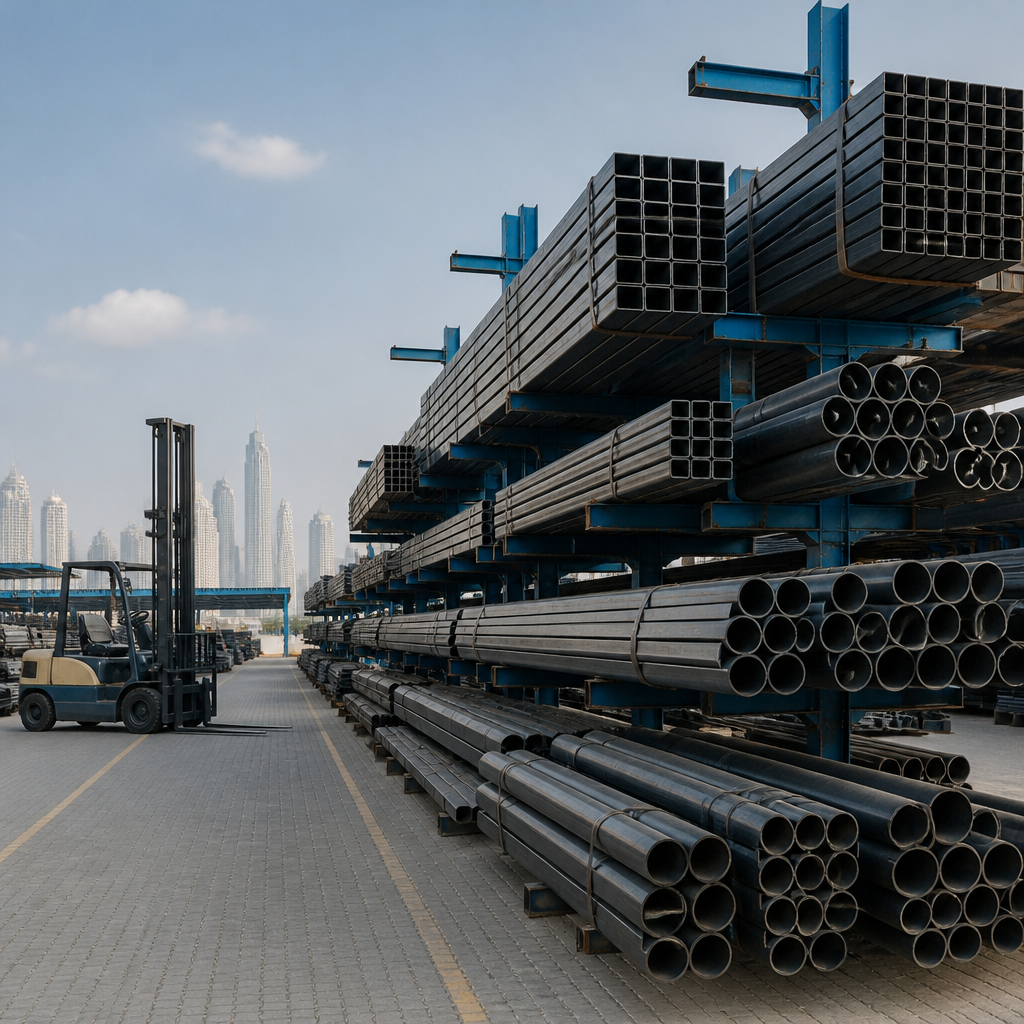
Stock depth is where location advantage becomes most tangible for buyers. Port-adjacent warehousing allows faster replenishment from inbound vessels, meaning a Jebel Ali-based stockholder can maintain ready stock of H-beams, hollow sections, plates, ERW pipes, and other structural products without the long replenishment wait periods that inland yards face after a stock drawdown.
Alpine Metals serves over 2,000 clients across the UAE and GCC from its Jebel Ali Free Zone base, supplying structural steel long products, flat products, tubes, and pipes. The product breadth this supports, including universal columns, universal beams, angles, channels, hollow sections, and a range of pipe specifications, is directly enabled by the port-adjacent location. Replenishment from inbound vessels happens without a secondary inland transport step.
Comparison: Sourcing Approaches for GCC Steel Procurement
Sourcing Approach
Key Strengths
Key Limitations for GCC Orders
Jebel Ali Free Zone Steel Stockist (e.g., Alpine Metals)
Zero re-export duty within JAFZA, port-adjacent replenishment, Mirsal 2 digital customs, direct road and sea corridors to all GCC markets, broad product range from single source
Minimum order quantities may apply for specialty products; best suited for mid-to-large volume orders
Inland UAE Distributor (Sharjah, Al Quoz, Abu Dhabi)
Convenient for small UAE mainland deliveries, local pickup flexibility
Secondary transport step to port adds cost and time for GCC exports; onshore customs duty on imports applies; narrower stock range typical; no JAFZA re-export duty exemption
Direct Mill Order (CIS, Asian, or European Mill)
Potentially lower unit cost on very large volumes, direct mill certification
Long lead times (weeks to months), minimum order quantities typically far larger, no flexibility for mixed-product orders, no value-added processing, full logistics coordination burden on buyer
The comparison makes clear that for construction companies and fabricators operating across multiple GCC markets, the Jebel Ali Free Zone stockist model is not just convenient. It is structurally better on the metrics that determine project delivery performance: duty structure, customs speed, product availability, and dispatch lead time.
Frequently Asked Questions
What makes a Jebel Ali steel supplier different from a Dubai mainland distributor?
A Jebel Ali-based steel supplier operating within JAFZA benefits from the free zone's customs structure, where goods can be imported, stored, and re-exported without paying UAE import duty. A mainland distributor pays the standard 5 percent import tariff when steel crosses into the UAE, a cost that either reduces their margin or gets added to your price. Additionally, JAFZA-based suppliers have direct port access for replenishment and faster digital customs processing via the Mirsal 2 platform.
Does a steel stockist in Jebel Ali Free Zone serve buyers outside the UAE?
Yes, and that GCC reach is one of the primary reasons for being based there. Road freight corridors from Jebel Ali reach Saudi Arabia, Oman, and Qatar directly. Feeder shipping services from Jebel Ali Port serve Kuwait, Bahrain, and Muscat on frequent schedules. The re-export duty exemption within JAFZA means buyers in those markets receive steel without a UAE customs duty component in the landed cost.
How does Jebel Ali Port connectivity affect steel lead times?
Jebel Ali Port connects to over 150 global ports with high-frequency vessel calls from major steel-producing regions including Asia and the Indian Subcontinent. This means mill stock replenishment cycles for a Jebel Ali stockist are shorter and more predictable than for distributors using smaller UAE ports. Shorter replenishment cycles mean higher probability that the specific product you need is in stock when you need it.
What structural steel products are typically available from a Jebel Ali-based stockist?
A well-stocked Jebel Ali distributor will typically carry a full range of structural long products, including universal beams, universal columns, angles, channels, and flat bars, alongside hollow sections, ERW and seamless pipes, and flat products such as plates and chequered plates. The breadth is greater than at inland yards because port-adjacent replenishment makes holding wide product ranges economically viable. Alpine Metals, operating in JAFZA since 1983, maintains this full range to serve construction and fabrication clients across the GCC.
Is JAFZA the right base for steel supply to Saudi Arabia specifically?
For Saudi Arabia, Jebel Ali is the most practical dispatch point in the UAE. The Hatta border crossing provides a well-established heavy-haulage route into Saudi Arabia, running directly from the Jebel Ali corridor. Combined with the JAFZA re-export duty exemption and digital customs processing, a Jebel Ali-based supplier can offer faster, more cost-effective delivery to Saudi project sites than an inland UAE distributor who adds road distance, customs complexity, and duty costs to the same shipment.
What value-added services can a Jebel Ali steel stockist offer that an inland yard cannot match?
Co-location within the JAFZA ecosystem means that material treatment services such as cutting to length, shot blasting, primer painting, and drilling can be performed within the free zone before dispatch, without the material ever leaving a bonded environment. This avoids the delays and double-handling involved when an inland stockist must send material to an external processor and retrieve it before shipping. For tight project timelines, this operational difference is significant.
If you are evaluating steel suppliers for an upcoming project in the UAE or wider GCC, we would like to hear what factors matter most to your procurement team. Share your experience or questions in the comments below.
We would love your feedback and any insights you would share with others. What perspective would you add?
References
JAFZA Metal, Steel and Construction Cluster: Trade Value and Company Data
How JAFZA Port Connectivity Supports GCC Steel Supply Chains
Jebel Ali Port 2024 Performance: Container and Breakbulk Cargo Growth
JAFZA Legal and Customs Structure: Free Zone Duty Exemptions Explained
Jebel Ali Port and JAFZA Growth in the Construction and Steel Sector

Comments