
Steel Stockist Dubai: 7 Criteria to Evaluate Suppliers
- 2 days ago
- 9 min read
Procurement teams in the UAE construction sector lose significant time and money every year because they chose a steel stockist based on price alone. A low quote that arrives with inconsistent grades, delayed shipments, or missing mill certificates can derail a project timeline faster than almost any other supply-chain failure. If you are sourcing structural steel in the UAE and want to avoid that outcome, you need a systematic way to evaluate every steel stockist Dubai has to offer before a single purchase order is raised.
Table of Contents
Quick Takeaways
Key Insight
Explanation
Mill certificates are non-negotiable
Any stockist unable to provide traceable mill test certificates for structural steel should be disqualified immediately, regardless of price.
Stock depth matters more than catalog breadth
A stockist listing 200 products but holding shallow inventory creates worse delays than one listing 80 products with reliable on-hand quantities.
Logistics is part of the product
In the UAE, last-mile delivery reliability to active construction sites directly affects project schedules. Evaluate delivery history, not just promises.
Material treatments reduce your subcontractor costs
Suppliers offering cut-to-length, shot blasting, or primer coating on-site save fabricators real money versus outsourcing those steps separately.
Longevity signals stability
A supplier operating in the UAE and GCC for decades has survived multiple market cycles, which directly lowers your supply-continuity risk.
Pricing transparency reveals commercial integrity
Opaque quotes with unexplained surcharges are a red flag. Reliable structural steel UAE suppliers break down base price, delivery, and any treatment costs clearly.
Technical support is a differentiator
Procurement teams working on complex structural projects need a supplier contact who can discuss grade specifications, not just invoice numbers.
Why Supplier Evaluation Matters Before You Buy
The UAE construction sector is one of the most demanding supply environments in the world. Projects in Dubai, Abu Dhabi, and across the GCC run on tight schedules, with penalties for delays that can reach tens of thousands of dirhams per day. Choosing a steel stockist Dubai based only on the lowest price per tonne is a mistake that experienced procurement managers make only once.
In practice, a poor supplier evaluation leads to three predictable failures: receiving off-specification material, waiting on back orders during peak project phases, and spending internal resources chasing paperwork that should have arrived with the delivery. A structured evaluation framework eliminates most of these risks before they become your problem on site.
The seven criteria below are drawn from the realities of procuring structural steel in the UAE and GCC market. They are not theoretical. Each one represents a failure mode that contractors and fabricators have actually experienced when they skipped the step.
">
Criterion 1: Product Range and Stock Depth
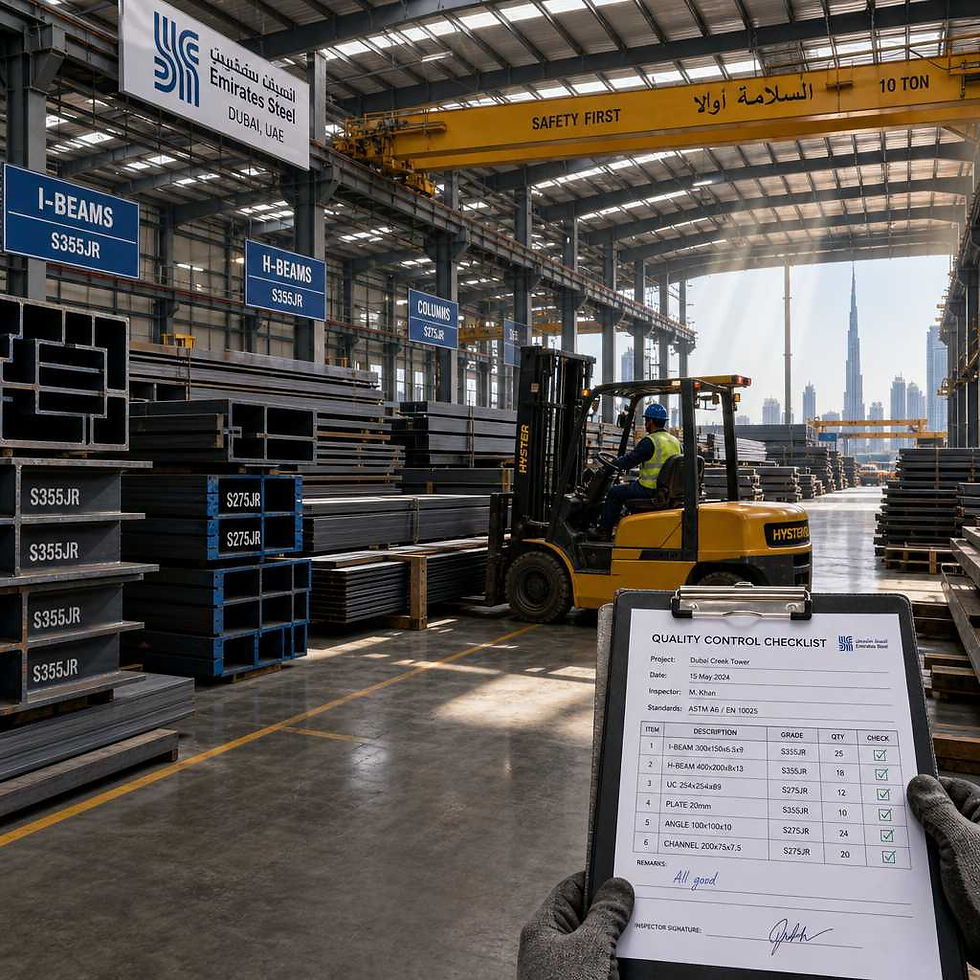
A serious steel stockist in the UAE carries more than one category of product. Look for suppliers who stock long products such as H-beams, I-beams, angles, channels, and flat bars alongside flat products including plates and sheets, as well as structural steel pipes and hollow sections. The breadth of range signals how many project types the supplier genuinely serves.
However, range without depth is a trap. A common mistake is to approve a supplier based on their product list, only to discover they hold three weeks of stock on the items you need and then go to back order. Always ask for live inventory levels, not just a catalog.
What to ask the supplier
Request current stock figures for your most-used sections. Ask what their average replenishment lead time is and who their mill sources are. A supplier who cannot answer those questions in detail is running a thin operation that will let you down on a time-critical project.
Pro tip: Ask whether the stockist holds safety stock buffers during Ramadan or peak construction season. Suppliers who plan for UAE market seasonality are operationally mature. Those who do not will create shortages precisely when your project pressure is highest.
Criterion 2: Quality Certifications and Mill Traceability
This is the non-negotiable criterion. Every tonne of structural steel destined for a UAE construction project must be accompanied by a valid mill test certificate confirming chemical composition and mechanical properties. If a stockist cannot provide original, traceable mill certificates, stop the evaluation there.
"Material traceability is not a procurement formality. It is the foundation of structural integrity on any project governed by international or UAE building codes." - Dubai Municipality Engineering Guidelines reference standard
Beyond mill certificates, look for ISO 9001 certification as evidence that the supplier has documented quality management processes rather than relying on individual staff judgment. Third-party inspection readiness is also a practical test: suppliers comfortable with third-party inspection have nothing to hide about their material sourcing.
Grades and standards to verify
Structural steel in the UAE typically needs to comply with EN 10025, ASTM A36, or equivalent standards depending on the project specification. Confirm that the stockist can source and certify material to the exact grade your engineer of record has specified, not merely a similar one. Grade substitution without written approval is a compliance failure, not a workaround.
Pro tip: Request a sample mill certificate during the supplier evaluation, before you place any order. A legitimate stockist will provide one without hesitation. If there is reluctance or delay, treat that as a meaningful signal about how they operate under normal commercial pressure.
Criterion 3: Years in Operation and Industry Track Record
Experience in the UAE steel distribution market is not just a marketing claim. It translates into established mill relationships, a proven logistics network, and accumulated knowledge about how UAE and GCC projects actually run. A supplier who has operated through multiple construction cycles understands the demand surges, the port congestion periods, and the specific requirements of major developers and contractors in the region.
Ask for client references and, specifically, request examples of projects the stockist has supplied in sectors comparable to yours, whether that is commercial high-rise, infrastructure, industrial, or oil and gas. A steel supplier who has delivered to major contractors across the UAE and GCC for decades is a fundamentally different risk profile from one who entered the market recently.
How to assess track record without being misled
Do not accept a generic client list. Ask for two or three specific project references where you can verify the supply scope, the quantities delivered, and whether delivery timelines were met. The data consistently shows that suppliers with a strong reference network have lower dispute rates than those who deflect reference requests.

">
Criterion 4: Logistics Capability and Delivery Reliability
In the UAE, moving heavy structural steel from a warehouse to an active construction site involves permits, scheduling around traffic restrictions in urban areas, and coordinating with site supervisors. A stockist without real logistics infrastructure passes that entire burden back to you.
Evaluate whether the supplier owns or controls its transport fleet. Ask about their record for on-time delivery in the emirate or emirate cluster your project is located in. Find out whether they have experience delivering to project sites in both Jebel Ali, Dubai, Abu Dhabi, and northern emirates, because lead times and routing differ significantly across those zones.
Critical logistics questions to ask
What is the maximum daily dispatch capacity? Do they carry abnormal load permits for oversized structural members? What happens when a delivery misses its slot due to site congestion? A supplier with clear protocols for these scenarios is operating professionally. One who gives vague answers is leaving you exposed to the consequences.
Criterion 5: Value-Added Material Treatment Services
Structural steel UAE projects increasingly require material that arrives ready for fabrication or erection, not raw sections that still need processing. A stockist who offers in-house cut-to-length services, shot blasting, and primer coating reduces the number of vendors you need to manage and compresses your project schedule.
For steel fabricators in particular, this criterion often determines whether a supplier is truly a supply partner or simply a warehouse. If a stockist can supply plates cut to your fabrication drawings, beams cut to span lengths, and pipes prepared to specified end conditions, your workshop throughput improves measurably.
Ask specifically which treatments are performed in-house versus subcontracted. In-house capability means faster turnaround and clearer accountability. Subcontracted treatments add lead time and introduce a quality handover point that can produce inconsistency.
Criterion 6: Pricing Transparency and Commercial Terms
Price matters. But opaque pricing is worse than a high price, because it makes forward planning impossible. A trustworthy steel supplier evaluation process always includes a detailed review of how a supplier structures its quotes.
A transparent quote should clearly separate the base material price per tonne, delivery costs, any treatment surcharges, and applicable VAT. Hidden surcharges for minimum order quantities, fuel levies, or documentation fees that only appear on the final invoice are a sign of commercial practices you do not want embedded in a long-term supply relationship.
Payment terms and credit availability
For construction companies managing cash flow across multiple projects, credit terms matter as much as unit price. Evaluate whether the supplier offers trade credit, what the standard payment terms are, and whether they have the financial stability to extend terms on large orders. A supplier under financial pressure will prioritize cash customers and delay credit accounts during shortage periods, which is exactly when you need them most.
Criterion 7: Responsive Customer Support and Technical Knowledge
The sales contact you speak to before an order is placed is not a reliable indicator of the support you will receive after the purchase order is raised. Before committing to a supplier, test the responsiveness and quality of their back-office team. Send a technical inquiry about a specific grade or section size and measure how quickly and accurately they respond.
In practice, procurement managers working on complex structural projects regularly encounter specification questions that require a technically knowledgeable supplier contact, not a junior sales representative reading off a price list. The best stockists in the UAE market maintain teams who understand the difference between S275 and S355 structural steel, can read a mill certificate correctly, and know when to escalate a technical query to a mill representative.
Responsive customer support also means accessible after-hours contact for urgent project needs and a clear escalation path when something goes wrong with a delivery. The absence of that structure is not a minor inconvenience. On a fast-track project, it is a genuine risk.
Comparison: How to Distinguish Strong Stockists from Weak Ones
Evaluation Area
Strong Stockist Profile
Weak Stockist Profile
Quality Documentation
Provides original mill test certificates with each delivery, ISO 9001 certified, welcomes third-party inspection
Offers partial documentation, substitutes grades without disclosure, resists third-party inspection
Inventory Management
Deep on-hand stock across long products, flat products, and pipes; publishes live inventory on request
Wide catalog but shallow stock; frequent back orders; relies on spot purchasing to fill orders
Logistics
Owns or controls delivery fleet; holds necessary permits; provides accurate ETAs with tracking updates
Relies entirely on third-party hauliers with no oversight; ETAs are estimates only; no permit management
Value-Added Services
In-house cut-to-length, shot blasting, primer coating; fast turnaround with quality accountability
Subcontracts all treatment; longer lead times; quality inconsistency at handover points
Commercial Transparency
Itemized quotes with clear base price, delivery, and treatment costs; stable payment terms for established clients
Bundled quotes with hidden surcharges; terms change at short notice; no credit facilities available
Frequently Asked Questions
What is the most important factor when evaluating a steel stockist in Dubai?
Mill traceability and quality certification are the most important factors because they directly determine whether the material is fit for use in a regulated construction project. Without verified mill test certificates, a price advantage on paper becomes a liability in practice. No other criterion overrides this one.
How do I verify that a steel supplier in the UAE is actually holding the stock they advertise?
Request a site visit to the warehouse or yard before committing to a supplier relationship. Alternatively, ask for a dated inventory report covering your specific product needs. Reputable stockists will provide this without hesitation. A supplier who refuses or deflects a stock verification request is signalling that their advertised inventory does not reflect reality.
What certifications should a structural steel supplier in the UAE hold?
At minimum, look for ISO 9001 quality management certification and the ability to supply material certified to internationally recognized standards such as EN 10025 or ASTM. Some projects and developers also require specific third-party inspection approvals or manufacturer qualifications from the mill source. Always cross-reference the required certifications against your project specification before approving a supplier.
How do value-added services from a steel stockist reduce project costs?
When a stockist performs cut-to-length, shot blasting, or primer coating in-house, you eliminate a subcontractor step and the associated coordination time, transport cost, and quality risk at each handover. For steel fabricators processing large volumes, receiving pre-cut material to fabrication dimensions alone can reduce workshop labor hours by a measurable percentage on a typical structural package.
Is a longer-established steel stockist always better than a newer entrant?
Not automatically, but established suppliers carry less supply-continuity risk for large or complex projects. A stockist who has operated in the UAE and GCC for decades has demonstrated the financial stability, mill relationships, and logistics infrastructure needed to sustain supply through market disruptions. For smaller, straightforward orders, a newer supplier with good certifications and transparent pricing can be appropriate. For mission-critical structural packages, the track record matters significantly.
How should I handle pricing comparisons between multiple steel stockists in the UAE?
Always compare quotes on a fully-delivered, landed basis at your site, not on an ex-warehouse basis. Include delivery costs, treatment costs, and any minimum-order surcharges in the comparison. A supplier quoting a lower base price but charging separately for delivery, documentation, and treatment will often be more expensive in total than a supplier with a slightly higher headline price and inclusive services.
Have you evaluated steel stockists in the UAE recently? Share what criteria mattered most in your supplier selection process, or let us know if there is a specific evaluation challenge you are working through.


Comments