
Steel vs Concrete: Specifying Structural Steel in UAE
Choosing between structural steel and concrete is not a neutral decision on UAE infrastructure projects. It is a choice that affects your programme, your cost trajectory, your structural performance in extreme heat, and your ability to meet the condensed timelines that define construction in Dubai and the wider GCC. The structural steel vs concrete UAE debate has sharpened considerably as project complexity rises and deadlines shrink. Based on decades of supply experience and client feedback across thousands of regional projects, the data consistently shows that steel is under-specified in scenarios where it would outperform concrete by a measurable margin.
Table of Contents
Quick Takeaways
Key Insight
Explanation
Steel cuts structural programme time by 20-40% on typical UAE mid-rise projects
Pre-fabricated steel members arrive ready to erect. Concrete requires formwork, curing time, and inspection hold points that eat weeks off tight delivery schedules.
High ambient temperatures reduce concrete early strength gain
UAE summer temperatures above 40°C significantly slow concrete hydration and introduce cracking risk. Structural steel is unaffected by ambient cure conditions.
Steel is the dominant material for long-span and column-free layouts
Warehouses, airport terminals, exhibition halls, and industrial facilities in the GCC almost universally specify structural steel because concrete cannot match the span-to-depth ratio economically.
Concrete typically wins on compression-dominant, high-rise cores
Reinforced concrete shear cores and flat-plate systems remain cost-competitive in high-rise residential and mixed-use towers where repetitive floor plates and compression loading favour the material.
Steel is fully recyclable, supporting UAE Net Zero 2050 commitments
Structural steel has an average recycled content of 60-90% and retains scrap value. Concrete demolition waste generates significant landfill burden. This matters for Estidama and LEED ratings in the region.
Supply chain certainty is a live risk in the GCC
Working with an established regional stockholder like Alpine Metals, which has operated since 1983, eliminates the lead-time uncertainty that project planners often attribute incorrectly to steel procurement.
Hybrid structures increasingly define complex UAE infrastructure
Metro stations, bridges, and mixed-use podiums in Dubai routinely use concrete cores with structural steel frames. Knowing which zones favour which material is the practical skill that separates good and poor specifications.
Why Material Choice Defines Project Outcomes
A common mistake in UAE project planning is treating the steel versus concrete decision as a late-stage detail to be resolved by the structural engineer alone. In practice, this choice has upstream consequences for procurement timelines, foundation design, fire protection strategy, and total installed cost. Making it early and making it correctly is a commercial discipline, not just a technical one.
The UAE construction sector delivered an estimated AED 176 billion in project awards in 2023, according to MEED Projects data. A significant share of those projects involved structural systems where the material specification was either not optimised or was carried over from previous project templates without fresh analysis. Both outcomes cost money.
For construction companies and steel fabricators working across Dubai, Abu Dhabi, and the wider GCC, the pressure to compress programmes and reduce rework means that the material specification decision deserves the same rigour as the procurement and logistics plan.

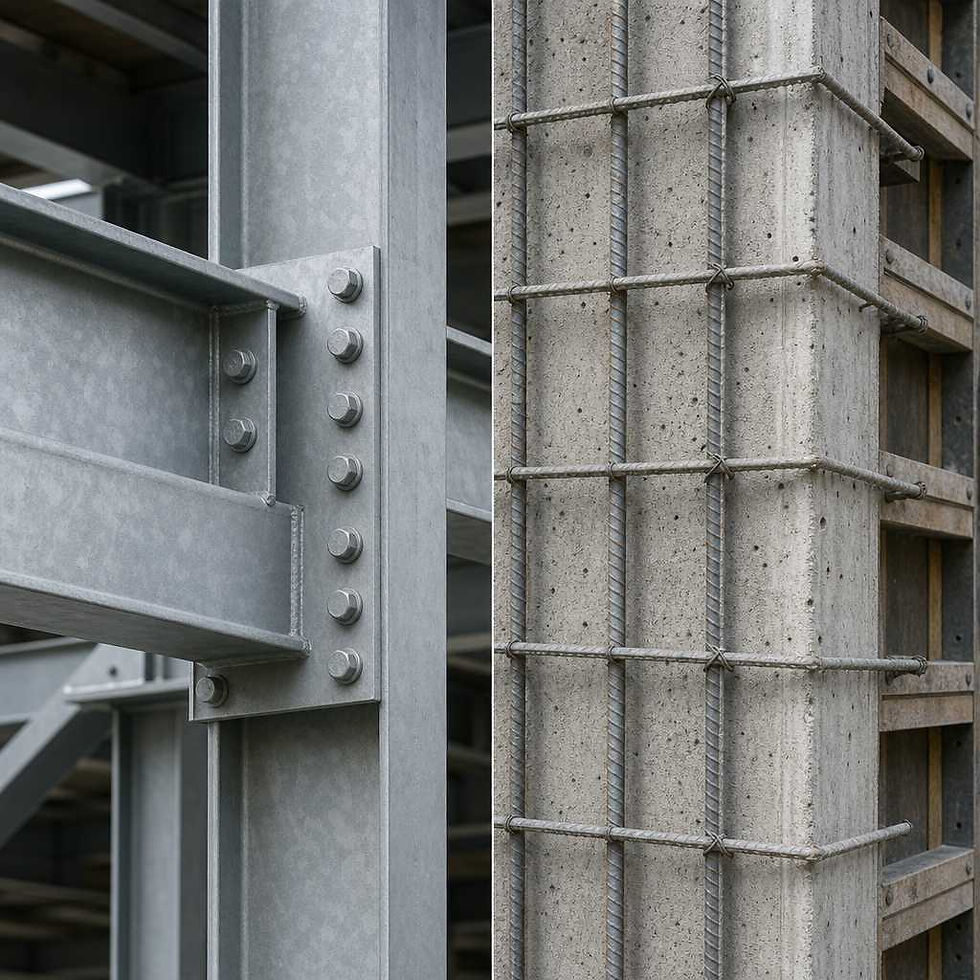
Structural Steel Performance in UAE Climate Conditions
The UAE climate creates specific challenges for both materials. Structural steel is sometimes dismissed on thermal grounds, but this concern is largely misplaced when appropriate fire and thermal protection is specified. The real climate challenge for concrete is more significant and less frequently discussed at the specification stage.
Heat Effects on Concrete in UAE Summer Conditions
Concrete placed at ambient temperatures above 38°C experiences accelerated hydration, which reduces long-term compressive strength and increases the probability of plastic shrinkage cracking. UAE municipality specifications require extensive cold-weather management in summer placements, including chilled water, ice aggregate substitution, and restricted pour windows. These add direct cost and logistics complexity on active sites.
The Abu Dhabi International Building Code and Dubai Municipality guidelines both impose strict controls on hot-weather concrete. In practice, compliance with these requirements on tight programmes often forces night pours, additional quality control holds, and extended curing supervision. None of these apply to structural steel erection.
Corrosion Considerations for Steel in Gulf Environments
The Gulf's high humidity, salt-laden coastal air, and occasional industrial atmosphere do require proper corrosion protection for structural steel. Hot-dip galvanising, high-build epoxy primers, and polyurethane topcoats are standard practice and well-understood in the UAE market. Specifying the correct coating system at design stage adds a modest and predictable cost. Ignoring it creates a lifecycle maintenance liability.
For buried or submerged elements, structural steel with cathodic protection consistently outperforms reinforced concrete in aggressive ground conditions, particularly in coastal reclamation zones where chloride ingress into concrete is a documented long-term structural risk.
Pro tip: When specifying structural steel for coastal UAE projects, require your supplier to provide mill certificates confirming steel grade and request coating system approval from the project's structural engineer of record before fabrication begins. This eliminates a common source of late-stage variation orders.
When to Specify Structural Steel Over Concrete
There are project types and structural scenarios where structural steel is not just a viable alternative to concrete but the objectively better specification. Treating it as anything less leaves programme and cost on the table.
Long-Span Industrial and Logistics Buildings
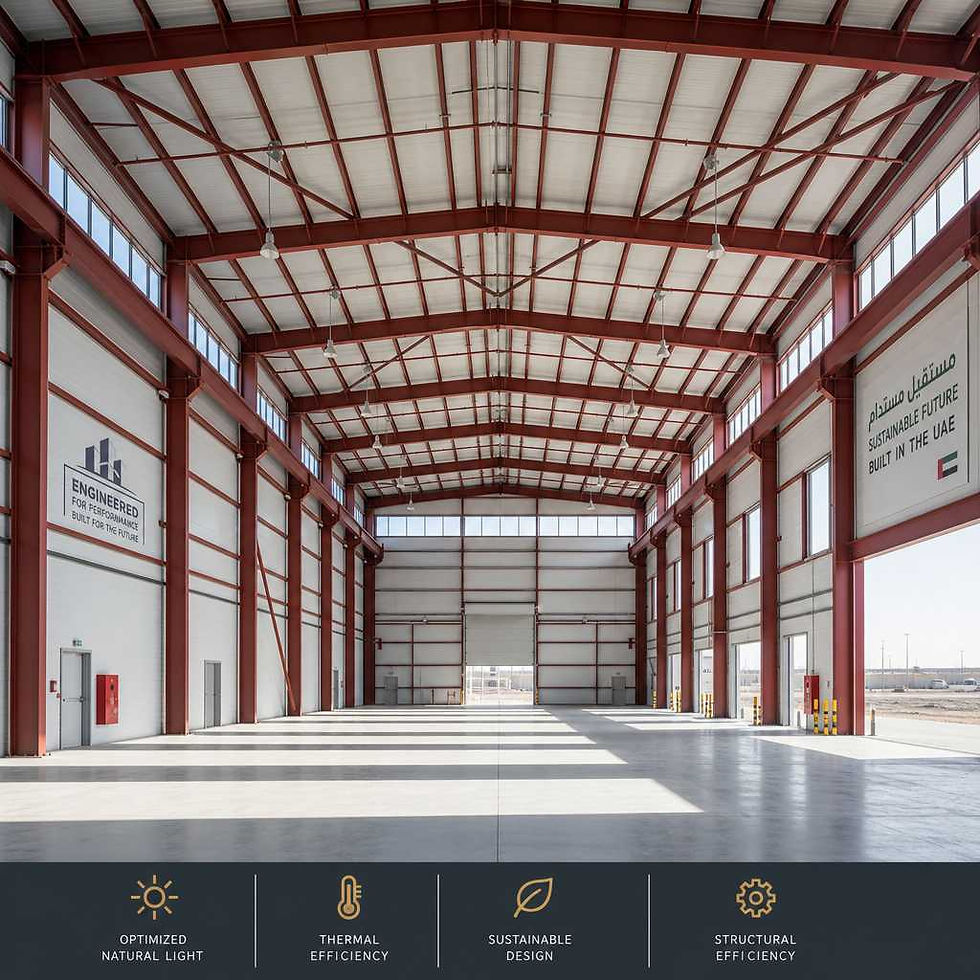
The UAE's logistics and warehousing sector is expanding aggressively, driven by e-commerce growth and the country's position as a regional distribution hub. Warehouses and distribution centres require clear-span internal layouts, typically 20 to 40 metres or more, with minimal internal columns. Structural steel portal frames and lattice trusses deliver these spans economically. A concrete alternative at equivalent span requires deep post-tensioned beams that add dead load, foundation cost, and storey height.
Fast-Track Commercial and Mixed-Use Projects
In practice, steel-framed buildings in the UAE can achieve structural completion two to four months faster than equivalent concrete frames on projects above ten storeys. Pre-fabrication off-site, concurrent floor plate construction during lower-level erection, and elimination of curing hold points all contribute. For developers paying monthly financing costs on large GCC projects, four months of programme compression is a material commercial saving.
Infrastructure Projects Requiring Phased Construction
Bridges, pedestrian overpasses, utility support structures, and transportation infrastructure in the UAE frequently require phased construction to avoid disruption to live roads or operational facilities. Structural steel sections can be fabricated to exact tolerances, transported to site, and erected in single shifts with minimal wet trades. Concrete alternatives require temporary works, curing time, and higher disruption windows.
Structures Requiring Future Adaptability
A defining feature of commercial real estate in Dubai is the frequency with which buildings are repurposed, extended, or reconfigured. Structural steel frames can be modified, strengthened with additional sections, or extended vertically with relative ease. Concrete structures require significant investigation, drilling, and structural intervention to achieve the same result. Specifying steel in buildings where future adaptability is commercially likely is a straightforward value-preservation decision.
When Concrete is the Right Call
Steel is not the correct specification for every situation. Intellectual honesty on this point matters for the credibility of any material recommendation.
High-rise residential towers with repetitive flat-plate floor systems, where vertical loads dominate and architectural flexibility is limited, typically favour reinforced concrete. The material's high compressive strength, thermal mass, and acoustic performance work well in this building type, and the repetitive formwork system amortises the setup cost over many identical floors.
Ground-bearing slabs, basement retaining walls, piled foundations, and infrastructure elements subject to continuous direct compression are all naturally suited to concrete. The material's cost per unit of compressive load capacity remains competitive, and it does not require the same surface protection maintenance that steel demands in exposed or partially exposed conditions.
The practical answer for many large UAE projects is a hybrid system: concrete core and podium structure combined with a structural steel frame for upper floors, long-span areas, or specialist zones. This is the specification logic behind several landmark Dubai developments and most of the larger airport and metro infrastructure in the region.
Head-to-Head Comparison: Steel vs Concrete for UAE Projects
The table below compares structural steel, reinforced concrete, and hybrid composite systems across the criteria that matter most on UAE and GCC infrastructure projects. These are working criteria used in real project specifications, not theoretical benchmarks.
Criterion
Structural Steel
Reinforced Concrete
Programme Speed (Mid-Rise)
20-40% faster structural programme; no curing holds
Slower due to formwork, pour sequencing, and curing requirements
Long-Span Capability (20m+)
Highly efficient; portal frames and trusses standard practice
Requires deep post-tensioned beams; significant dead load penalty
Hot Weather Construction
Unaffected by ambient temperature; erection proceeds in summer
Requires cold-water cooling, ice, and restricted pour windows above 38°C
Sustainability and Recyclability
60-90% recycled content; fully recyclable at end of life; supports LEED and Estidama credits
Significant demolition waste; limited recycling value; higher embodied carbon per tonne
Structural Adaptability
Easily modified, extended, and strengthened; low intervention cost
Requires coring, resin anchors, and structural review for any modification
Initial Material Cost
Higher per tonne but typically offset by programme savings and reduced foundation loads
Lower per cubic metre but total project cost advantage narrows on complex layouts
Fire Protection Requirement
Intumescent coating or board encasement required; adds cost and programme
Inherent fire resistance from concrete cover; no additional protection on most elements
Supply Chain Certainty in GCC
High when sourced from established regional stockholders with on-ground inventory
Dependent on local ready-mix capacity and aggregate supply, which can constrain large pours
Steel Infrastructure Dubai: What the Numbers Say
Steel infrastructure in Dubai and the UAE is not a niche segment. The World Steel Association reports that global steel demand from the construction sector accounts for approximately 52% of total steel consumption, and the GCC construction boom of the past decade has consistently tracked above global averages in structural steel intensity.
"The UAE construction sector's drive toward faster delivery and greater design flexibility is creating a structural preference for steel framing in non-residential building types. Projects that previously defaulted to concrete are now being re-evaluated at design stage." - MEED, Gulf Construction Market Report
Dubai Expo 2020 infrastructure, Al Maktoum International Airport expansion, and multiple phases of Dubai Metro all involved large-scale structural steel specification. These are not isolated examples. They reflect a broader pattern in which steel infrastructure in Dubai is used wherever programme, span, or adaptability requirements exceed what concrete can deliver within acceptable parameters.
The UAE government's National Infrastructure Plan, which targets investment exceeding AED 200 billion through 2027, includes water treatment plants, renewable energy structures, transport corridors, and industrial zones. The majority of these project types favour structural steel as the primary framing material, particularly in industrial and utilities categories.
Pro tip: If you are a fabricator or contractor bidding on UAE infrastructure tenders, request certified mill test reports and full material traceability documentation from your steel supplier at the enquiry stage, not post-award. Alpine Metals has provided full traceability documentation as standard since its earliest operations, which prevents the compliance delays that plague procurement from less-established distributors.
Cost and Programme Realities on UAE Sites
The most persistent misconception in the structural steel vs concrete UAE debate is that steel always costs more. This is false at the project level, even when it is sometimes true at the material unit cost level.
True Cost Comparison Requires Total Installed Cost Analysis
A steel frame typically imposes lower dead loads on the structure than an equivalent concrete frame, which directly reduces foundation size and cost. On UAE sites with variable ground conditions, particularly in coastal reclamation zones, foundation cost savings from reduced superstructure weight can fully offset the premium in steel material cost. This calculation is routinely skipped in early-stage cost comparisons that use only material rates.
Programme Compression Has Measurable Financial Value
For a developer financing a 100,000 square metre mixed-use project at a cost of AED 500 million, a four-month programme saving on structural completion translates directly into reduced interest carry cost, earlier revenue generation, and improved investment returns. Using steel's programme advantage as a financial argument, not just a technical one, changes the tenor of specification discussions at developer level.
Availability and Lead Times from Regional Stock
One legitimate cost and programme risk with structural steel is procurement lead time from overseas mills. This risk is substantially mitigated when working with a regional stockholder that holds physical inventory in the UAE. Alpine Metals has maintained on-ground stock of structural steel sections, hollow sections, plates, and pipes continuously since 1983, serving clients across the UAE and GCC with reliable, short-notice supply. The difference between sourcing from a regional stockholder and waiting for a mill order is frequently the difference between a project that holds its programme and one that does not.
Frequently Asked Questions
Is structural steel more expensive than concrete for UAE projects?
At the material unit level, structural steel typically costs more per tonne than reinforced concrete per cubic metre. However, total project cost comparisons consistently show that steel's lighter weight reduces foundation costs, its faster erection reduces programme finance costs, and its off-site fabrication reduces on-site labour costs. On industrial, logistics, and long-span projects in the UAE, steel is frequently the lower total installed cost option once all variables are counted.
How does UAE summer heat affect the structural steel vs concrete choice?
UAE summer temperatures above 38-40°C significantly complicate concrete placement. Hot-weather concrete measures including chilled water, ice substitution for aggregate, restricted pour windows, and extended curing supervision add cost and time. Structural steel erection is not affected by ambient temperature, making steel-framed projects more resilient to summer construction conditions than concrete alternatives.
Which projects in the UAE most commonly specify structural steel?
Warehouses, distribution centres, airport terminals, exhibition halls, pedestrian bridges, industrial facilities, utility structures, and fast-track commercial buildings are the most common structural steel applications in the UAE. These project types share a common need for long spans, fast programmes, or future adaptability, all of which structural steel delivers more effectively than reinforced concrete.
What steel grades and sections are typically used in UAE structural applications?
S275 and S355 structural steel grades are the most common in UAE and GCC construction, covering universal beams, universal columns, hollow structural sections, and welded sections. S355 is increasingly preferred for its higher yield strength, which allows lighter sections and reduces dead load. Plate material in grades S275 and S355 is widely used for fabricated sections and connection details. Alpine Metals stocks the full range of these grades as a regional supplier and stockholder.
Does structural steel perform well in UAE coastal environments?
Yes, when specified and protected correctly. Coastal UAE environments with high humidity and salt-laden air require a robust corrosion protection system, typically a hot-dip galvanised or high-build epoxy primer base with a polyurethane topcoat. These systems are standard practice in the region and well understood by local fabricators and applicators. Lifecycle maintenance is required but predictable. In some submerged or buried coastal conditions, steel with cathodic protection outperforms reinforced concrete, which is susceptible to chloride-induced reinforcement corrosion.
How does specifying structural steel support UAE sustainability targets?
Structural steel has an average recycled content of 60 to 90% and retains full scrap value at end of life, making it a genuinely circular material. It contributes positively to Estidama Pearl Rating and LEED credit categories related to materials and resources. The UAE's Net Zero 2050 strategic initiative and green building mandates across Dubai and Abu Dhabi are increasing the weight that developers and public clients place on embodied carbon in material specifications, a category where structural steel has a measurable advantage over conventional reinforced concrete on a lifecycle basis.
What should construction companies ask a steel supplier before specifying structural steel on a UAE project?
Ask for confirmation of physical stock availability in the UAE rather than reliance on spot import orders. Request mill certificates with full material traceability to the originating steel plant. Confirm that the supplier can provide material in the required grades, section sizes, and lengths from existing regional inventory. Ask whether material treatment services such as shot blasting and primer coating are available locally. Alpine Metals provides all of these as standard services from its UAE operations.
What has been your experience specifying structural steel versus concrete on UAE or GCC projects? Share your observations below, as practical site-level insight helps the whole industry make better decisions.


Comments