
Structural Steel Products UAE Contractors Must Know
The UAE construction sector moves fast, and steel procurement mistakes are expensive. A wrong grade specified on a high-rise in Dubai, a delayed pipe delivery on a GCC pipeline project, or a structural section that fails a load calculation review - these are not hypothetical problems. They happen when contractors treat structural steel products UAE suppliers offer as interchangeable commodities. They are not. Knowing which products fit which applications, which grades matter under which loads, and how to read a material certificate can save a project weeks and hundreds of thousands of dirhams.
Table of Contents
Quick Takeaways
Key Insight
Explanation
Grade specification errors cost money
Ordering S235 when a design calls for S355 forces rework, structural re-assessment, and project delays that no liquidated damages clause will fully cover.
Universal Beams and Universal Columns are not the same product
UBs carry bending loads efficiently. UCs handle axial compression. Using one in place of the other is a structural engineering error, not just a terminology issue.
Hollow Section selection affects fabrication cost
Circular Hollow Sections (CHS) are harder to weld at connections than Rectangular Hollow Sections (RHS) and Square Hollow Sections (SHS). Choosing the right profile upfront reduces fabrication hours.
Mill certificates are non-negotiable in the GCC
Every reputable steel contractor Dubai side should demand EN 10204 Type 3.1 or 3.2 certificates. Anything less creates compliance risk on governed projects.
Pipe schedules determine pressure ratings
ASTM A53 and API 5L pipes carry different schedule designations that directly control wall thickness and pressure capacity. Mixing them up on a utility project is a safety issue.
Stock availability affects critical-path scheduling
UAE-based stockholders who carry physical inventory on the ground reduce lead times from 8-12 weeks (mill order) to days. That difference is a scheduling advantage on fast-track projects.
Construction steel GCC sourcing should account for corrosion environment
Coastal UAE projects demand either weathering steel, hot-dip galvanized sections, or additional paint systems. This should be specified at procurement, not addressed after fabrication.
Why Product Knowledge Matters for UAE Contractors
A structural steel products UAE procurement decision is rarely just a purchasing decision. It is an engineering decision that ripples through design approval, fabrication scheduling, site delivery, and ultimately structural performance. The contractors who treat it as a pure cost exercise tend to encounter the most expensive problems.
In practice, the most common errors seen across UAE construction projects involve over-specifying heavy sections when lighter ones would satisfy the load case, or under-specifying wall thickness on pipes handling utility loads. Both errors share the same root cause: the contractor or quantity surveyor does not have a working knowledge of the product range available.
The UAE construction market consumed over 8 million tonnes of steel in 2023, according to data tracked by the World Steel Association. With mega-projects like the continuation of UAE Vision 2031 infrastructure programs and the ongoing GCC rail and energy network expansions driving demand, the pressure on contractors to procure accurately and quickly has never been higher.


Long Products Explained: Beams, Columns, and Angles
Long products form the skeleton of almost every steel-framed structure in the UAE. They are hot-rolled sections produced in continuous lengths, then cut to specification. Understanding the differences between section types prevents costly substitution errors.
Universal Beams (UB) and Universal Columns (UC)
Universal Beams carry predominantly bending loads. Their wider, thinner flanges relative to their web depth make them efficient for spanning horizontally across framing grids. A 457x191 UB, for example, is a common choice for floor beams in multi-storey steel frames across Dubai commercial developments.
Universal Columns carry axial compression loads. Their near-square cross-section distributes stress more evenly through their flanges and web, making them the correct choice for vertical load-bearing members. A common mistake is specifying a UB in a column position because it appears heavier on paper. The section geometry makes it structurally inferior for that application regardless of weight per metre.
Angles, Channels, and Flat Bars
Equal angles (L-sections with equal leg lengths) and unequal angles are workhorses in secondary steelwork, bracing systems, and connections. They are also the most frequently over-ordered category because estimators sometimes apply blanket allowances rather than specific length calculations.
Channels (UPE and UPN profiles) serve as purlins, side rails, and edge members. Flat bars handle plate stiffeners, base plate assemblies, and small connection components. In fabrication shops across the UAE, these sections make up a large share of the offcut waste that drives material cost overruns. Accurate take-offs from structural drawings reduce this waste directly.
Pro tip: When ordering angles and channels from a UAE stockholder, confirm whether the supplied lengths are random mill lengths or cut-to-length. Random lengths require additional cutting at the fabrication shop, which adds time and labour cost that is rarely priced into the initial steel quotation.
Flat Products: Plates, Sheets, and Their Applications
Flat products cover a broad range of thicknesses and surface conditions, each suited to specific structural or fabrication applications. The two main categories used by steel contractors in Dubai and the broader UAE are hot-rolled plates and cold-rolled sheets, with hot-rolled being far more prevalent in structural applications.
Structural Plates for Base Plates and Gussets
Hot-rolled structural plate in grades S275 and S355 is used for base plates under column stanchions, gusset plates at truss nodes, and splice connections in moment-resisting frames. Thickness typically ranges from 6mm to 100mm depending on the connection design.
In practice, connection details drive plate procurement more than any other factor. A gusset plate specified at 20mm in the engineer's connection schedule that gets substituted with 16mm plate because of stock availability is not a minor deviation. It changes the capacity of the connection and requires re-approval from the structural engineer of record.
Chequered Plates and Wear-Resistant Grades
Chequered plates are common across UAE industrial, oil and gas, and infrastructure projects for flooring, stair treads, and access platforms. They come in mild steel and higher-tensile grades. Wear-resistant grades like AR400 and AR500 are used in applications involving abrasion, such as hoppers, chutes, and bulk material handling equipment on GCC port and mining developments.
Pro tip: For coastal UAE projects, specify hot-rolled plates with a mill-applied shot blast and primer coat. Ordering bare plate and applying surface treatment on-site is consistently more expensive and produces a less uniform result than sourcing treated material directly from a supplier equipped with the correct shot blast facilities.

Steel Pipes and Tubes for Construction and Infrastructure
Steel pipes and structural tubes serve two fundamentally different functions. Structural hollow sections carry loads in frames and trusses. Steel pipes, by contrast, convey fluids and gases in utility, oil and gas, and infrastructure systems. Specifying the correct product for the application is not optional - it affects both safety and compliance.
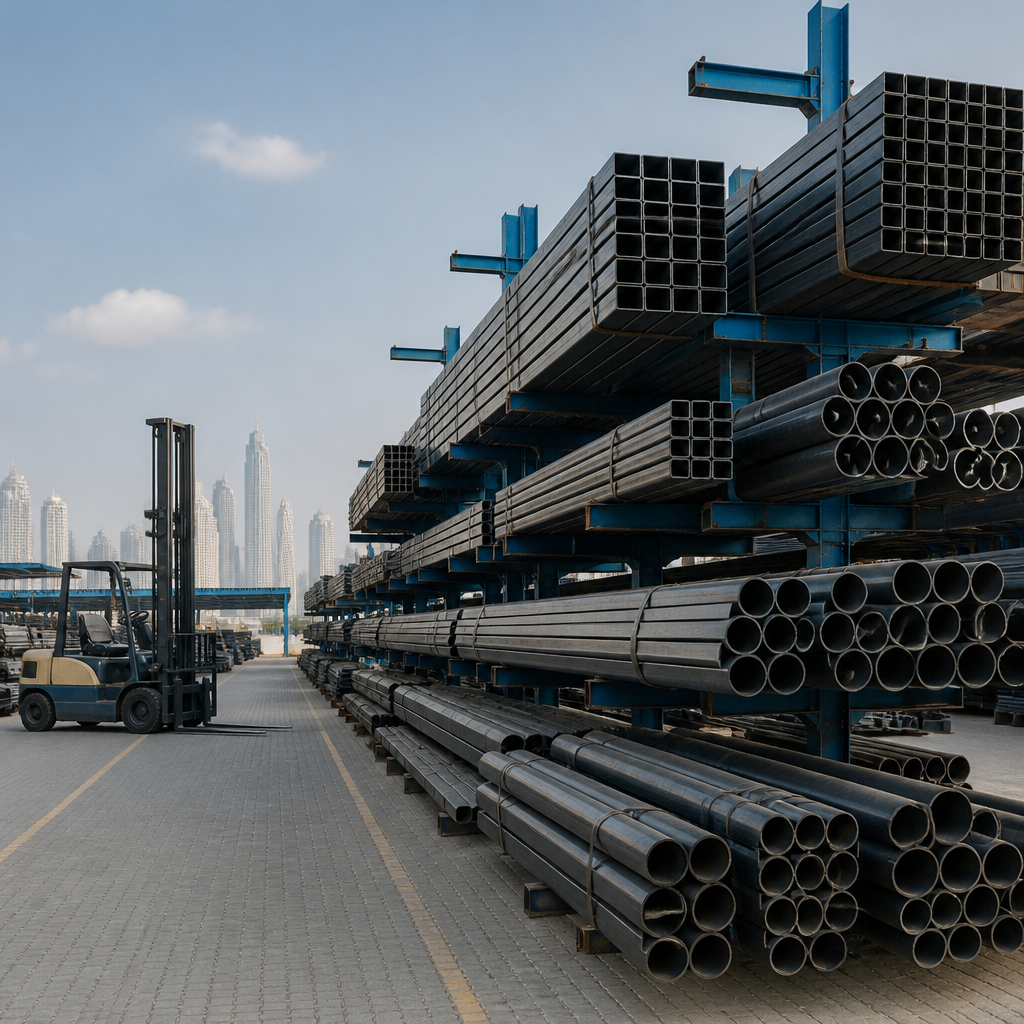
Structural Hollow Sections: CHS, RHS, and SHS
Circular Hollow Sections (CHS) offer excellent torsional resistance and aesthetic appeal, making them common in exposed architectural steelwork, masts, and canopy structures across UAE retail and hospitality projects. Rectangular Hollow Sections (RHS) and Square Hollow Sections (SHS) are more practical in fabricated frames because their flat faces simplify beam-to-column connections and gusset plate attachments.
The data consistently shows that SHS sections in the 100x100 to 200x200 range are among the highest-volume structural hollow section products consumed by steel contractors in Dubai for light industrial buildings, mezzanine frames, and modular construction. Keeping these in mind when planning procurement ensures faster site delivery.
Steel Pipes for Infrastructure Projects
On infrastructure and utility projects across the GCC, the two most cited standards are ASTM A53 for general structural and pressure applications, and API 5L for oil and gas transmission lines. These are not interchangeable. API 5L PSL2 includes additional chemical composition and mechanical property requirements not present in A53.
A common mistake on cross-disciplinary GCC projects is allowing the procurement team to source API 5L pipe for a structural support application because it is available in the right diameter, without confirming whether the schedule and grade match the structural design requirements. Always verify the mill certificate against the specification, not just the outer diameter and wall thickness.
Steel Grades and Standards Across the GCC
The GCC construction market uses a mix of European (EN), American (ASTM/AISC), and sometimes BS standards depending on the client, consultant, and project origin. UAE projects led by European consultants typically specify EN 10025 grades: S235, S275, and S355. American-influenced projects specify ASTM A36 and A572 Grade 50.
"The choice of steel grade is not an arbitrary cost decision. S355 carries a minimum yield strength of 355 MPa versus S235 at 235 MPa. Substituting a lower grade to save on material cost without structural re-analysis is a liability that no contractor should accept." - Structural steel procurement guidance, British Constructional Steelwork Association
In practice, S355 has become the default structural grade for most medium to large commercial and industrial projects in the UAE because the marginal cost premium over S235 is typically less than 5 to 8 percent of the steel line item, while the strength uplift allows for lighter, more economical section sizes that reduce overall steel tonnage and fabrication hours.
For construction steel GCC projects operating under ADNOC or Saudi Aramco specifications, supplementary requirements on impact testing (Charpy values at specific temperatures) and through-thickness properties (Z35 grade designation for thick plates) apply. Contractors working in this sector who are not familiar with these requirements will face material rejection at inspection.
Comparison of Structural Steel Product Types
Product Type
Primary Structural Application
Key Specification Standard (UAE/GCC Common)
Universal Beam (UB / IPE)
Floor beams, roof rafters, spanning horizontal members in steel frames
EN 10025-2 (S275/S355), BS 4-1
Universal Column (UC / HEA/HEB)
Vertical load-bearing columns, heavily loaded compression members
EN 10025-2 (S275/S355), BS 4-1
Square and Rectangular Hollow Sections (SHS/RHS)
Light industrial frames, mezzanine structures, bracing members
EN 10219 (cold-formed), EN 10210 (hot-finished)
Hot-Rolled Structural Plate
Base plates, gussets, splice plates, fabricated girder flanges
EN 10025-2, ASTM A36/A572
Steel Pipe (Structural and Utility)
Structural supports, fluid conveyance, oil and gas transmission
ASTM A53 (structural/utility), API 5L (oil and gas)
Material Treatments and Surface Preparation
Surface treatment is not a finishing detail to be sorted after fabrication. It is a specification decision that affects cost, schedule, and performance in the corrosive coastal environment found across much of the UAE and GCC coastline. Getting this right at the procurement and design stage saves significantly more money than rework after delivery.
Hot-Dip Galvanizing vs. Paint Systems
Hot-dip galvanizing (HDG) to EN ISO 1461 provides zinc coating thicknesses typically above 85 microns on structural sections and is the preferred treatment for exposed external steelwork on UAE infrastructure projects: guardrails, walkways, cable trays, stairways, and secondary structural members. The process is irreversible and provides sacrificial cathodic protection that a paint system alone cannot replicate.
Paint systems are the standard for primary structural steel in enclosed or partially enclosed environments. A typical UAE structural steel paint specification for an industrial building might call for a two-coat system: one coat of zinc phosphate epoxy primer at 75 microns dry film thickness, and one coat of polyurethane topcoat at 50 microns. For aggressive industrial and offshore environments, three-coat systems with epoxy intermediate coats are common.
Shot Blasting and Surface Cleanliness Standards
Surface preparation grade directly affects paint adhesion and long-term coating performance. Sa 2.5 (near white blast clean, ISO 8501-1) is the industry standard for structural steel in the UAE before applying epoxy-based coatings. Sa 3 (white metal blast) is specified for the most severe marine and chemical exposure categories.
Suppliers who offer in-house shot blast facilities allow contractors to receive shot-blasted and primed steel ready for fabrication, eliminating a separate sub-contracting step and reducing the handling damage that comes with moving bare steel between facilities.
Procurement and Logistics in the UAE
Procurement from a stockholder versus a direct mill order is not a trade-off between cost and speed alone. It is also a trade-off between flexibility and commitment. For large, predictable steel packages on long-lead projects, a mill order negotiated months in advance through a distributor like Alpine Metals gives cost certainty and the ability to specify exact lengths, grades, and surface treatments to the project requirement. For fast-moving fit-out and secondary steelwork needs, drawing from a stockholder's physical UAE inventory is the only realistic option.
The UAE's position as a regional hub means that Jebel Ali Port provides access to mill production from Europe, Turkey, South Korea, and India. A steel contractor Dubai based who understands the lead times from each origin can plan procurement windows intelligently. Turkish and CIS mill lead times are typically 6 to 10 weeks to UAE port. European mills supplying specialty grades can run 12 to 16 weeks. Local UAE stockholder delivery on standard sections can be same-day or next-day for projects in Dubai and Abu Dhabi.
Logistics beyond delivery to site also matters. Cut-to-length services, bundling by mark number for erection sequence, and delivery coordination with site crane availability are services that differentiate a full-service steel supplier from a basic commodity seller. These services reduce handling time on site and reduce the risk of issuing steel to the wrong erection bay, which on large-frame structures is a surprisingly common and expensive error.
Pro tip: When placing a steel order for a complex fabrication package, ask your supplier to bundle sections by structural mark number in sequence with your fabrication shop's cutting schedule. This single coordination step regularly eliminates 20 to 30 percent of internal materials handling time in a fabrication workshop, which translates directly into a faster shop turnaround.
Frequently Asked Questions
What is the difference between S275 and S355 structural steel in UAE construction?
S275 has a minimum yield strength of 275 MPa and S355 has a minimum yield strength of 355 MPa. Both are used widely in UAE construction, but S355 allows the structural engineer to specify lighter sections for the same load, which often reduces overall steel tonnage and fabrication cost despite a slightly higher material cost per tonne. For most commercial and industrial projects in the UAE, S355 is the preferred default grade.
What mill certificate standard should a steel contractor in Dubai require?
The correct standard is EN 10204 Type 3.1 as a minimum, which provides a certificate validated by the manufacturer's own authorized inspection representative. For critical structural applications or projects under regulated client specifications such as ADNOC or DEWA, Type 3.2 certification with third-party inspection body sign-off may be required. Never accept a basic test report (Type 2.2) for primary structural steel on a governed project.
Which hollow section type is best for a light steel frame in the UAE?
For light industrial buildings, mezzanine decks, and canopy structures, Square Hollow Sections (SHS) and Rectangular Hollow Sections (RHS) to EN 10219 are the most practical choice. They are easier to connect at column-to-beam junctions than CHS, they stack and transport more efficiently, and they are widely stocked by UAE distributors in the most common sizes. CHS becomes the better choice when torsional resistance or architectural appearance is the primary driver.
How do I ensure structural steel sourced for a GCC project meets local project specifications?
Start with the project specification document and identify the required grade, standard (EN, ASTM, or BS), and any supplementary requirements such as impact testing temperatures or through-thickness properties. Then confirm with your supplier that they can provide mill certificates covering all those requirements before placing the order. If the supplier cannot produce documented evidence that the material meets the specification, do not accept the material regardless of price. Replacement costs always exceed savings made on a non-compliant supply.
What is the typical lead time for structural steel delivery in the UAE?
From a UAE-based stockholder with physical inventory, standard sections such as UBs, UCs, angles, channels, and common hollow sections can typically be delivered within one to three working days to Dubai and Abu Dhabi sites. Mill-order lead times through a distributor range from 6 weeks for nearby origins like Turkey to 12 to 16 weeks for European specialty mills. Planning your procurement window against your fabrication start date is the single most impactful scheduling decision on a steel-framed project.
Does coastal location in the UAE affect which structural steel products I should specify?
Yes, significantly. Coastal UAE locations fall into corrosivity category C4 or C5 under ISO 12944, which requires either hot-dip galvanizing, high-performance multi-coat paint systems, or both depending on whether the steel is exposed or enclosed. Specifying bare or primer-only steel for external applications in coastal zones like Dubai Marina, Yas Island, or any offshore or port structure is a maintenance liability that will create visible corrosion within a few years and require early recoating at significant cost.
What structural steel products have you found most challenging to source accurately for UAE or GCC projects? Share your experience below so other contractors can benefit from what you have learned on the ground.

Comments