
Alpine Metals: Best Steel Supplier in Dubai for Pipes
Dubai project managers rarely think about steel until a delivery slips by two weeks and a fabrication crew sits idle. The problem is usually not the metal itself. It is a supplier who cannot confirm what is in stock, cannot produce the right mill certificates, or cannot get material to site in the right order. If you are searching for Alpine Metals or the best steel supplier in Dubai, the useful question is not who has the biggest catalogue. It is who can deliver the right carbon steel pipes and mild steel sections on the date your schedule needs them. This guide explains how Alpine Metals approaches that job and how you can test any supplier against it.
Table of Contents
Quick Takeaways
Key Insight | Explanation |
|---|---|
Ask for stock position before you ask for price | A quote built on real availability lets your site team plan cuts and erection sequences. A quote built on a guess often becomes a delay. |
Match every pipe to its certificate | Check that the heat number stamped on the pipe matches the mill test certificate in the delivery pack before the truck is unloaded. |
Specify wall thickness and end finish, not just size | Two pipes with the same outside diameter can behave very differently in welding and fit-up. Put wall thickness and bevel requirements on the purchase order. |
Order mild steel with a trimming allowance | Complex frames generate offcuts and rejected pieces. Adding a margin to the bill of materials is cheaper than an urgent top-up order. |
Treatment and logistics belong in the same conversation | Priming, cutting to length and bundling by erection area reduce yard handling and crane waiting on congested Dubai sites. |
Confirm the drawing revision on every order | Steel ordered from an older drawing can be correct in grade and size for a frame that no longer exists. |
Why Alpine Metals Stands Out in Dubai's Steel Market
Alpine Metals has supplied structural steel since 1983, and that continuity matters more than any catalogue. Long products, flat products, tubes and pipes are handled under one roof, so a fabricator can place a mixed order instead of splitting purchases across several vendors. Serving thousands of clients across the UAE and GCC means the team has seen most of the ways a steel order can go wrong, from wrong grades to material that arrives on the wrong truck.

The real value shows up before the order is placed. A supplier that tracks its own stock can quote a project from actual availability, which lets site teams plan cuts and erection sequences with confidence. Where Alpine Metals differs from many traders is scope. Material treatments and logistics sit inside the same relationship, so steel leaves the yard prepared for the job rather than delivered as raw stock.
Serving Projects Across the UAE and GCC
Dubai is the hub, but the work rarely stays in one emirate. Contractors running projects in other UAE emirates and across the wider GCC need consistent specifications and documentation wherever the steel is erected. A supplier with that regional experience treats cross-border paperwork as routine rather than as an emergency.
The cheapest tonne of steel is the one that arrives on the day the crew needs it, with paperwork that matches what was ordered.
In practice, most regional disputes are about documentation and timing, not about the price per tonne. Ask any supplier how they handle both before you commit a large package.
Carbon Steel Pipes for UAE Projects
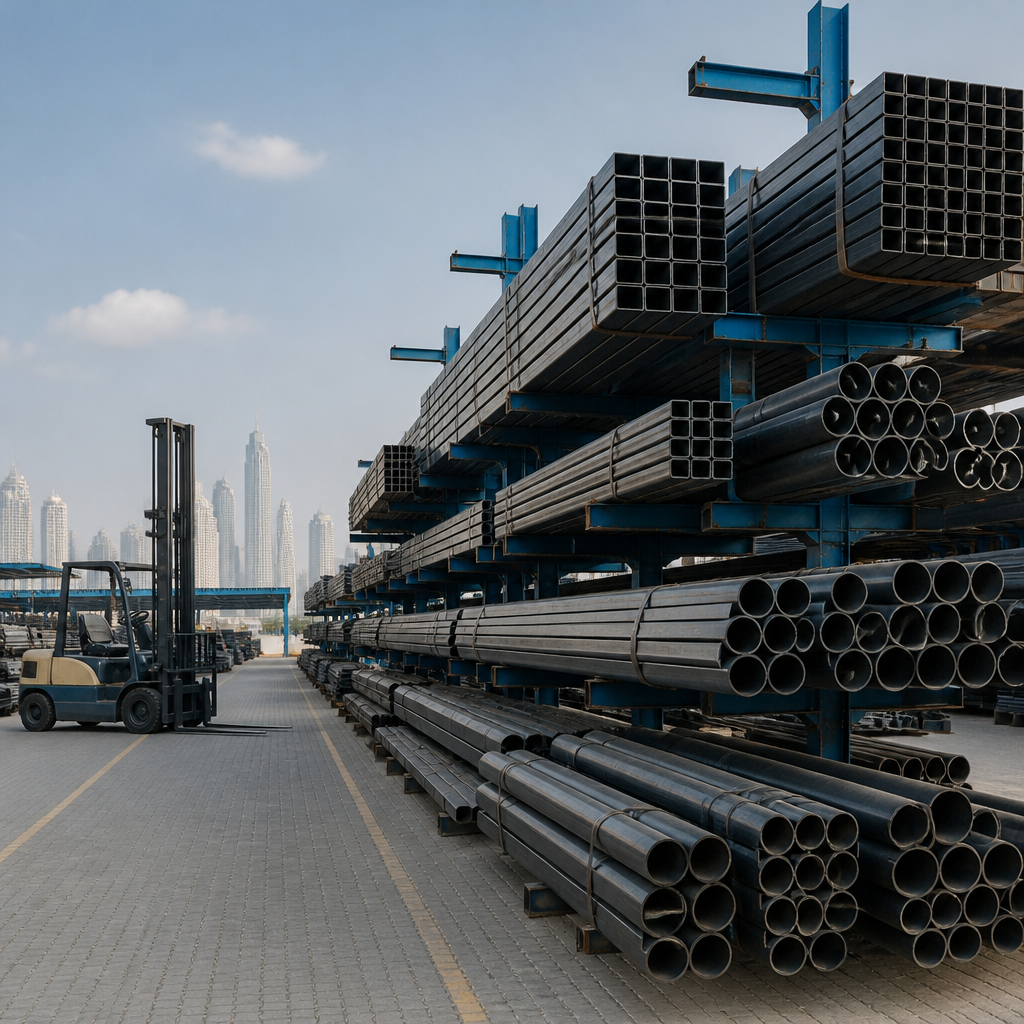
Carbon steel pipes are central to UAE infrastructure, from utility lines to hollow sections in building frames. Searching for carbon steel pipes suppliers in Dubai will return many names, but the real differences show up in grade, wall thickness and finish, not in a brochure.
Matching Pipe Grade and Standard to the Application
Start with the design drawing and the governing standard, not the price. A pipe specified for structural duty and a pipe specified for fluid transport can look identical on a rack and still be different products. Ask for the mill test certificate and confirm that the heat number on the pipe matches the paperwork.
Wall thickness deserves the same scrutiny. A thin-wall pipe can pass a visual check and still distort during fit-up or fail a welding procedure. Fabricators often discover this only after a crew has spent a full day on a frame.
Pipe Ends, Coatings and Storage Before Delivery
Bevelled ends, cut lengths and protective coatings are not optional extras. A pipe cut to the wrong length on site costs far more than one cut correctly at the yard. Dust, salt air and standing water are constant issues in the Gulf, so pipe should be stored off the ground, ends should stay capped, and coatings should be inspected on arrival.
Pro tip: Before you accept a pipe delivery, pull three pieces at random and check the marking, length and end finish against the packing list. Problems found on the truck are cheap to fix. Problems found on the scaffold are not.
Mild Steel Solutions for Fabricators and Contractors
Mild steel remains one of the most frequently ordered materials on UAE sites because it is weldable, predictable and widely used in standard sections. For fabricators, the challenge is rarely finding mild steel. It is getting the right section, length and tolerance in the same order, delivered on time.
Standard Sections and Cut-to-Length Requests
Beams, channels, angles, flats and plates are most efficient when cut to the lengths on your shop drawings. A supplier that cuts to length reduces offcuts in your yard and gives you usable, labelled pieces. Send your cutting list in the same format as your drawings and ask for piece marks to stay with each bundle.

Ordering Mild Steel Without Losing the Schedule
A common mistake is ordering only the quantity listed in the bill of materials. Experienced fabricators add a margin for trimming, rejected pieces and rework. The right margin depends on the complexity of the job, but ordering exact quantities for a complex frame almost always leads to a second, urgent order that arrives late.
If the project has fixed milestones, confirm quantities early and agree on delivery windows before fabrication begins. Late changes to section sizes are where most mild steel budgets quietly overrun.
Material Treatment and Logistics That Protect Your Schedule
Material treatment covers the work done between the mill and your fabrication floor, including blasting, priming, cutting, marking and bundling. Each step has a cost, but skipping them moves that cost to your site, where it is harder to control.
Surface Preparation and Priming Before Fabrication
Steel that is blasted and primed at the supplier's yard is cleaner and easier to work with than material that has sat uncovered through a Gulf summer. Confirm the coating system against the project specification before the order is released. A coating that suits a warehouse may not suit an exposed façade.
Delivery Planning for Congested Sites
Dubai construction sites are tight, and deliveries that arrive in the wrong order block cranes and crews. Ask for loads to be sequenced by erection area and mark each bundle with its location. Good logistics planning means the truck that leaves the yard in the morning carries what the crane needs in the afternoon.
Be explicit about offloading equipment, gate access hours and the name of the person who signs for the load. Many delays are not caused by the steel but by a truck waiting at a gate with no clear instructions.
Pro tip: Send your supplier a site delivery sheet that lists gate hours, crane location and the receiving contact. It takes about ten minutes to prepare and removes most of the avoidable waiting.
How to Choose a Steel Supplier in Dubai
The phrase best steel supplier in Dubai means different things to a small fabrication shop and to a main contractor running a large frame. Set your criteria before you request quotes, then judge every supplier against the same list.
Four Checks Before You Sign a Purchase Order
First, ask what is held in stock and what must be imported. Second, ask for mill test certificates and confirm they match the material you receive. Third, ask who handles treatment and logistics and whether they answer to the same team. Fourth, ask for references from projects of similar scale.
A supplier that answers these questions quickly and plainly is usually easier to work with when a job becomes difficult. Vague answers at the quotation stage tend to turn into disputes later.
Comparing Common Buying Approaches
Most UAE buyers choose between three routes. The table below sets out how they compare on a typical project, and where each one fits best.

Buying Approach | Typical Lead Time | Best Fit |
|---|---|---|
Ready stock from a stockholder | Usually fastest, subject to current stock levels | Repeat sizes, smaller batches and urgent repairs |
Import for a specific grade or size | Longer, set by mill and shipping schedules | Large orders with fixed specifications and time to plan |
Spot purchase from a trader | Variable, depends on what can be sourced | Single, low-risk items where documentation is less critical |
As a stockholder and distributor, Alpine Metals is most useful on the first route, where fast-moving orders depend on what is on hand. For projects that need a specific grade, confirm the lead time in writing before you commit the schedule.
Common Mistakes When Buying Steel for UAE Projects
Most steel problems on Gulf projects trace back to paperwork or planning rather than to the metal itself. These are the mistakes that come up most often.
Ordering Against an Outdated Drawing
Revisions happen late in design. If the fabricator orders from an older drawing, the steel may be correct for a frame that no longer exists. Confirm the drawing revision number on every purchase order and repeat it on the delivery note.
Accepting Material Without Checking Documents
Receiving teams often sign for the truck and count the pieces, then skip the certificates. Compare heat numbers and markings against the paperwork at the gate, not weeks later when a welder raises a question on site.
Also, steel that looks right may still be wrong for the job. Check with the design team before substituting a grade or section, even when the substitute is available today.
Frequently Asked Questions
Why is Alpine Metals considered a strong choice for steel in Dubai?
The case rests on continuity and scope. Alpine Metals has operated since 1983, supplies long products, flat products, tubes and pipes, and offers treatment and logistics alongside supply, which reduces the number of vendors a project has to manage.
What should I check when a carbon steel pipe delivery arrives?
Check the marking, length and end finish on a sample of pieces, and match the heat numbers to the mill test certificates. Confirm wall thickness and coating condition as well, because these are the points where problems tend to appear during fit-up or welding.
Do you supply mild steel for projects outside Dubai?
Alpine Metals serves clients across the UAE and the wider GCC. Confirm the specific sections, quantities and delivery window when you request a quote, so the supplier can check stock and logistics for your location.
How can I verify a steel supplier's documentation before ordering?
Ask for a sample mill test certificate and check that it names the grade, standard and heat numbers you need. Ask how the supplier links each certificate to physical stock, because that link is what protects you if a question comes up later.
Is ready stock always better than importing steel?
Ready stock is usually faster and better for repeat sizes, smaller batches and urgent work. Imports make more sense for large orders with fixed specifications, provided you plan the lead time early and confirm it in writing.
What has your experience been with steel suppliers in Dubai, and which factor, price, stock availability or delivery reliability, has mattered most on your last project?

Comments