
Hot-Rolled vs Cold-Formed Steel: A UAE Specification Guide
Ask five engineers on a Dubai project which steel section they want and you may get five different answers, usually depending on whether they came up through the design office or the fabrication shop. The choice matters more than it looks. A hot-rolled section and a cold-formed member can look similar on a drawing and even share a depth, yet they behave differently under load, at connections and in the workshop. Getting the process right at the specification stage of a hot-rolled steel sections UAE project prevents rework, delivery disputes and difficult site conversations. This guide explains where each product belongs, what to write into your specification, and where the common mistakes happen.
Table of Contents
Quick Takeaways
Key Insight | Explanation |
|---|---|
Default to hot-rolled for primary members | Columns, main beams and bracing usually carry the primary load path. Thicker hot-rolled sections and predictable geometry suit these members. |
Use cold-formed for repetitive secondary elements | Purlins, girts and wall studs are where coil-based cold-formed sections earn their place, provided the thin-wall checks are done in the design. |
Tolerances drive the connection strategy | Hot-rolled dimensions vary as the steel cools, so allow for packing and camber at bolted joints. Cold-formed sections are more consistent, but thin gauges need careful fastener selection. |
Never substitute on section size alone | A section with the same depth from a different rolling route is not an equivalent member. Check the process, grade and design basis before accepting a substitution. |
Specify surface preparation, not just a coating | Hot-rolled mill scale must be removed before painting or galvanizing. Name the preparation level on the drawing so the coater does not price a standard job for a scaled surface. |
Match mill certificates to every delivery | Check heat numbers, grade and rolling route on the certificates against the purchase order before any steel is cut. |
Rolling Temperature and Steel Behavior
Rolling means passing steel through a series of rollers to reduce its thickness and improve uniformity, and the temperature at which this happens defines the product. Hot rolling takes place above the steel's recrystallization point, typically over 1,700°F. Cold rolling happens at or near room temperature, after the steel has already been hot rolled.
In practice, temperature controls three things an engineer cares about: strength, surface finish and dimensional accuracy. Hot-rolled steel is worked while hot and then cools in air. As it cools it shrinks non-uniformly, so the finished section carries small variations in shape that are acceptable for most building frames but must be planned for in the connections.

What Air Cooling Does to the Member
Hot-rolled sections cool at room temperature, which leaves them essentially normalized. That means they are largely free from the internal stresses that quenching or work-hardening can introduce. For a member that will be welded and loaded for decades, that is a sound starting point. You also get good ductility and toughness, which matters at connections that need to yield rather than crack.
Why Cold Working Changes the Picture
Cold-rolled steel is re-rolled at room temperature after hot rolling. That extra step improves surface finish, raises strength and tightens dimensions, but it also reduces ductility and makes the material harder to form. You pay more for consistency and strength, and you accept less forming flexibility. A common mistake is to assume cold-worked material will bend and weld like hot-rolled plate. It often will not, and fabricators who learn that on the shop floor lose time and material.
The steel you choose is not just a grade name. The rolling route decides how the member moves, how tightly it can be made and how it performs at the connection.
Hot-Rolled Sections in Practice
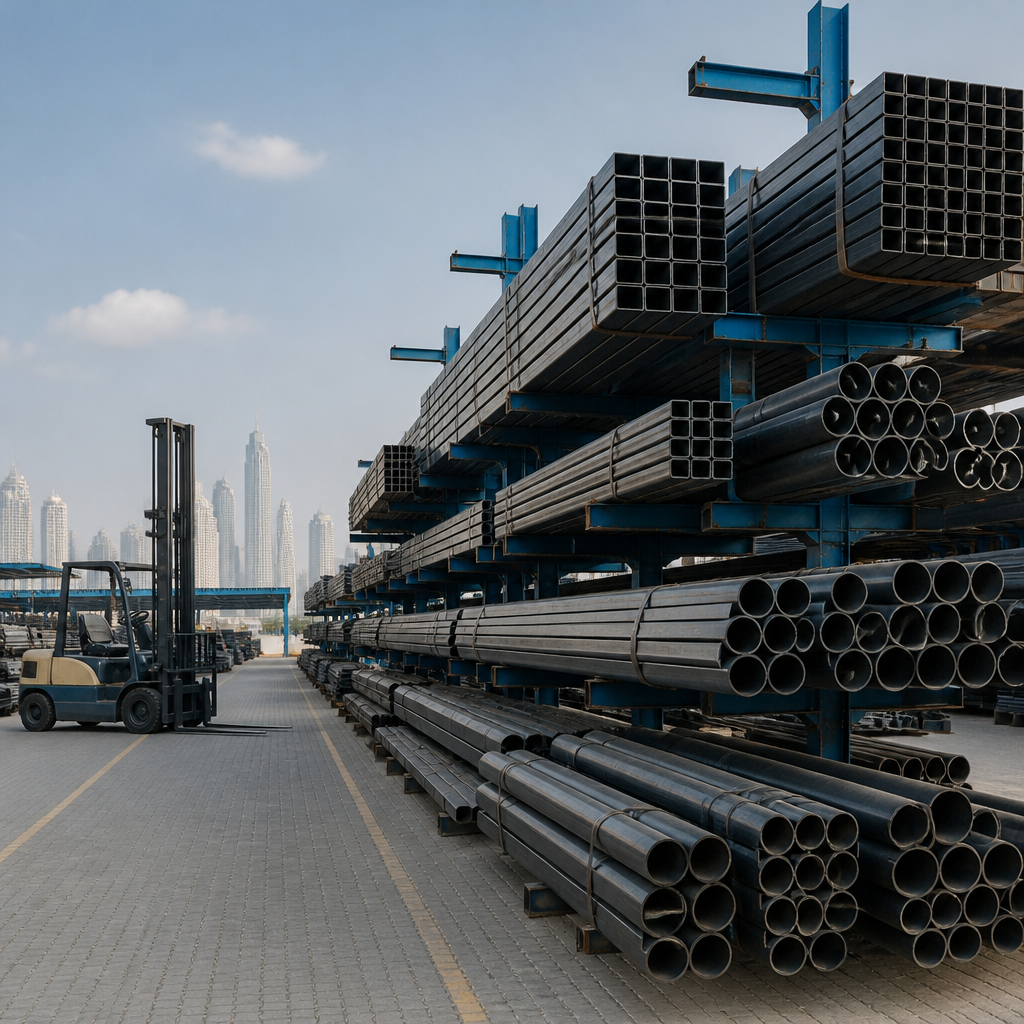
Hot-rolled sections are the workhorse of the primary frame. Beams, columns, channels, angles and hollow sections in the structural range are typically produced this way, and they dominate frames for warehouses, industrial buildings and multi-storey structures. The product is well understood by fabricators, which keeps the shop schedule predictable.
Where Hot-Rolled Sections Earn Their Place
Use hot-rolled sections for members that carry concentrated loads, span meaningful distances or sit in the main load path. These sections are thick enough that local buckling is less often the governing problem than in thin-walled cold-formed members, and their geometry is predictable when cutting, drilling and welding to drawing. On a UAE project where one contract covers the frame, a mezzanine and a plant platform, the same hot-rolled grade can often cover the whole primary structure, which simplifies procurement.
Tolerances and What They Mean on the Shop Floor
Hot-rolled sections carry looser dimensional tolerances than precision cold-worked products. Depth, flange width and straightness can vary within the permitted band, and that matters when you bolt a beam to a column or set base plates. Detail the tolerance class from the product standard, not the nominal dimension alone. Leave packing allowance at bolted connections and check camber before erection rather than after.
Surface is the other practical issue. Hot-rolled steel carries a scaly mill surface that must be removed before painting or galvanizing, usually by pickling, grinding or blasting. A common mistake is leaving preparation to the coating applicator, who then discovers the scale after pricing a standard job.
Pro tip: Measure a sample of incoming beams for depth and straightness before cutting a full batch. Ten minutes at the stockyard can prevent a day of rework in the fabrication bay.
Cold-Formed Sections and Coil Framing
Cold-formed steel (CFS) framing starts with steel coil, which is roll formed at room temperature into channels, studs, tracks, purlins and girts. Because the forming is cold and the material is thin, the member's strength comes largely from its shape. This is the family behind most lightweight roof purlins and internal wall framing in warehouses and commercial buildings.
How CFS Members Are Made
Coil is fed through a series of forming rolls that bend the flat strip into the final profile in one continuous line. Because the process runs continuously, profiles can be cut to length and produced in repeatable batches. That repeatability is why CFS suits repetitive secondary elements, where dozens of identical studs or purlins are needed for a building envelope.
The Thin-Wall Design Trap
The principal risk with cold-formed members is local and distortional buckling of thin walls. For that reason, they must be designed to the cold-formed provisions of the governing code, not treated as scaled-down hot-rolled sections. Engineers who swap a CFS member for a hot-rolled one of similar depth without redoing the checks often find the substitute behaves differently. Keep the design basis in the specification so the fabricator cannot quietly change the product.
Connections deserve the same care. Thin gauges are sensitive to fastener choice, edge distance and hole quality. A fastener that suits a thick plate can tear through a thin wall. Specify fastener type, tightening method and minimum edge distances on the drawing, not in an email.
Side-by-Side Specification Comparison
Set the decision rule before you look at the table. Choose by where the member sits, how it is loaded and how it will be connected, not by which product looks cheaper per tonne. A heavier hot-rolled member can still be the better buy once you count erection time, connection detailing and the number of parts on site.

Criterion | Hot-Rolled Sections | Cold-Formed Sections |
|---|---|---|
Production route | Rolled at high temperature, then cooled in air | Coil re-rolled at room temperature into a profile |
Typical role | Columns, main beams, bracing, base frames | Purlins, girts, wall studs, light roof framing |
Dimensional tolerance | Looser, with variation from cooling | Tighter and more repeatable in profile |
Surface finish | Scaly mill surface needing preparation | Smoother surface, depending on the coil finish |
Forming and welding | Conventional cutting, drilling and welding | Limited forming, careful procedures for thin gauges |
Best fit | Primary frames with concentrated loads | Repetitive secondary elements over long spans |
Reading the Table for a Real Project
Treat the table as a starting point rather than a rulebook. For a primary frame in a tall or heavily loaded building, hot-rolled is almost always the right answer. For roof purlins across a long warehouse bay, cold-formed is usually the economic choice, as long as the thin-wall checks are carried out in the design. Mixed systems are normal, and the specification should state which member belongs to which system.
Writing the Specification for UAE Projects
A specification that says "150 UB" or "100 x 50 channel" leaves too much open. Name the product process, the grade, the governing product standard and the tolerance class. Then state the surface preparation and coating system, and require mill test certificates with heat numbers. Those six items cover most of the disputes we see on site, because they remove the guesswork about what was actually ordered.
Clauses That Prevent Expensive Substitutions
Write a substitution clause that requires written approval from the engineer of record for any change in process, grade or section family. A substitution that looks harmless in the stockyard can change the design basis entirely. The clause should also define what counts as an equivalent, so the fabricator and the buyer are working from the same rules when a size is out of stock.
Coating Decisions in the Gulf Climate
Coastal humidity and airborne salt in the Gulf accelerate corrosion of unprotected steel, so the coating specification belongs in the structural specification, not in a separate painter's scope. Decide early whether a member will be galvanized, painted or left to a primer, and tie that decision to the surface preparation level. At Alpine Metals, the projects that run smoothly across the UAE and wider GCC are the ones where steel is specified by process, grade and finish before the first purchase order is raised. You can review the structural steel range we stock at Alpine Metals.
Fabrication, Connections and Corrosion
Fabrication is where the specification meets the cutting table, so the details matter. The workshop needs to know which members are hot-rolled and which are cold-formed, because the two groups need different handling. Mixing them in one cutting list without that information is a frequent cause of errors.
Cutting, Drilling and Welding Hot-Rolled Members
Hot-rolled sections handle conventional cutting, drilling and welding with predictable results. Mill scale and the corner radii of rolled profiles can still affect fit-up, especially on long members with tight bolted connections. Measure before you cut, clean weld zones and confirm that drilled holes align with the marked positions on both flanges and webs.
Making Cold-Formed Connections Work
Thin-gauge connections need approved fasteners, correct driving tools and a careful eye on edge distances. Overdriven screws strip the wall, and underdriven ones loosen under vibration. Welding thin gauge material requires qualified procedures, because burn-through is a real risk. Where the manufacturer specifies a fastener system, use that system and do not mix brands on the same connection.
Galvanizing and Coating Compatibility
Thick hot-rolled members are routinely galvanized, but thin cold-formed members are more prone to distortion during hot-dip galvanizing. Confirm the process with the coater before detailing, and send the actual section list with wall thicknesses. A thin-wall member batched with thick sections is a known route to warping, which then has to be corrected on site or rejected.
Pro tip: Send the coater the actual section list and wall thicknesses before detailing. Coating plans are built around thickness, and a mixed batch of thin and thick members is harder to process cleanly.
Procurement and Material Traceability
Procurement is where the specification proves itself. The buyer's job is to confirm that what arrives matches the drawing, and that the paperwork matches the steel. Stockholders can help by holding common sizes and providing certificates with every delivery, but the final check belongs to the project team.

Checking Mill Certificates Against Your Drawings
Match the heat number, grade and chemical and mechanical properties on each certificate to the purchase order and the drawing. Confirm that the certificate states the rolling route, because a hot-rolled certificate does not describe a cold-formed member. Reject bundles where the heat numbers cannot be traced to the paperwork, and do it before the steel reaches the cutting bay.
Managing Substitutions and Lead Times
When a size is out of stock, a substitution from a different rolling route is a structural change, not a purchasing convenience. Route it back to the engineer of record for approval. Plan lead times early for non-standard sizes, since specials take longer than common hot-rolled profiles. Building the schedule around stocked sizes where the design allows is often the simplest way to protect the programme.
Frequently Asked Questions
Can I replace a hot-rolled section with a cold-formed one of the same depth?
Not without redoing the design checks. Cold-formed members are thin-walled, so their buckling behavior and connection capacity differ from a hot-rolled member of the same depth. Any change needs approval from the engineer of record.
Is cold-formed steel stronger than hot-rolled steel?
There is no simple answer. Cold working raises the strength of the material, but cold-formed members are thin and their capacity depends heavily on shape and buckling. Compare members on their design capacity under your actual load case, not on material strength alone.
Why does hot-rolled steel have a scaly surface?
The scale forms during high-temperature rolling and cooling in air. It must be removed through pickling, grinding or blasting before painting or galvanizing, or the coating will not perform as intended.
Which system should I specify for purlins in a UAE warehouse?
Cold-formed purlins are the usual choice for long-span roof systems because they are light, repeatable and economic in volume. The purlin design, fixings and bracing should be checked to the governing code and detailed clearly on the drawings.
What should a structural steel specification include?
At minimum, it should state the rolling process, grade, governing product standard, tolerance class, surface preparation, coating system and traceability requirements. It should also include a substitution clause that requires engineering approval for any change in process or grade.
Do I need mill test certificates for every delivery?
For structural work, yes. Certificates matched to heat numbers are the only reliable way to confirm that the steel delivered is the steel you designed for, and they protect everyone in the chain if a question arises later.
Which section type causes the most trouble on your projects, and what specification clause finally fixed it for you?

Comments