
Hollow Structural Sections UAE: Complete Guide for Fabricators
Most steel fabricators in the UAE treat all hollow structural sections as interchangeable commodities. They order by size, accept whatever grade arrives, and then wonder why their welding distorts or their project specs fail inspection. Hollow structural sections in UAE construction are not a commodity decision. The grade, wall tolerance, surface condition, and whether your supplier actually stocks the profile you need, all of these determine whether your fabrication runs on schedule or bleeds margin. This guide covers what experienced UAE fabricators already know and what newer contractors need to learn fast.
Table of Contents
Quick Takeaways
Key Insight
Explanation
Grade S355 is the default for most UAE structural work
S235 is underspecified for high-load applications in the GCC. Most engineers in the UAE default to S355J2H for HSS columns and trusses due to its higher yield strength and toughness at low temperatures.
Wall thickness tolerance affects weld quality directly
A minus tolerance on wall thickness beyond EN 10219 Class A limits creates inconsistent heat input during welding, leading to distortion and failed inspections. Always request mill certificates that confirm thickness tolerance class.
Cold-formed vs hot-formed matters for corner radius
Cold-formed RHS and SHS sections have tighter corner radii, which limits weld access in gusset plate connections. Hot-formed sections are preferred where connection geometry is complex.
Corrosion protection must start at procurement, not at painting stage
In Dubai's coastal and high-humidity zones, internal corrosion of sealed HSS is a real risk. Specifying end-sealed or internally treated profiles before delivery prevents warranty issues on long-span canopy structures.
Stock availability in the UAE drives project timelines more than price
A supplier quoting a lower price on imported stock with 6-week lead times can delay a project more than a locally stocked supplier charging 5% more. Confirm physical stock, not just catalog availability.
Not all tubes and pipes in Dubai are the same product
Structural hollow sections and mechanical or fluid-conveying pipes are manufactured to different standards. Using EN 10219 or EN 10210 profiles for structural connections and not fluid pipe grades is non-negotiable on engineered projects.
UAE steel fabrication often demands dual certification
Projects with international consultants or government clients frequently require both EN and ASTM certifications on the same batch of material. Confirm your supplier can provide this before committing to a delivery schedule.
What Are Hollow Structural Sections?
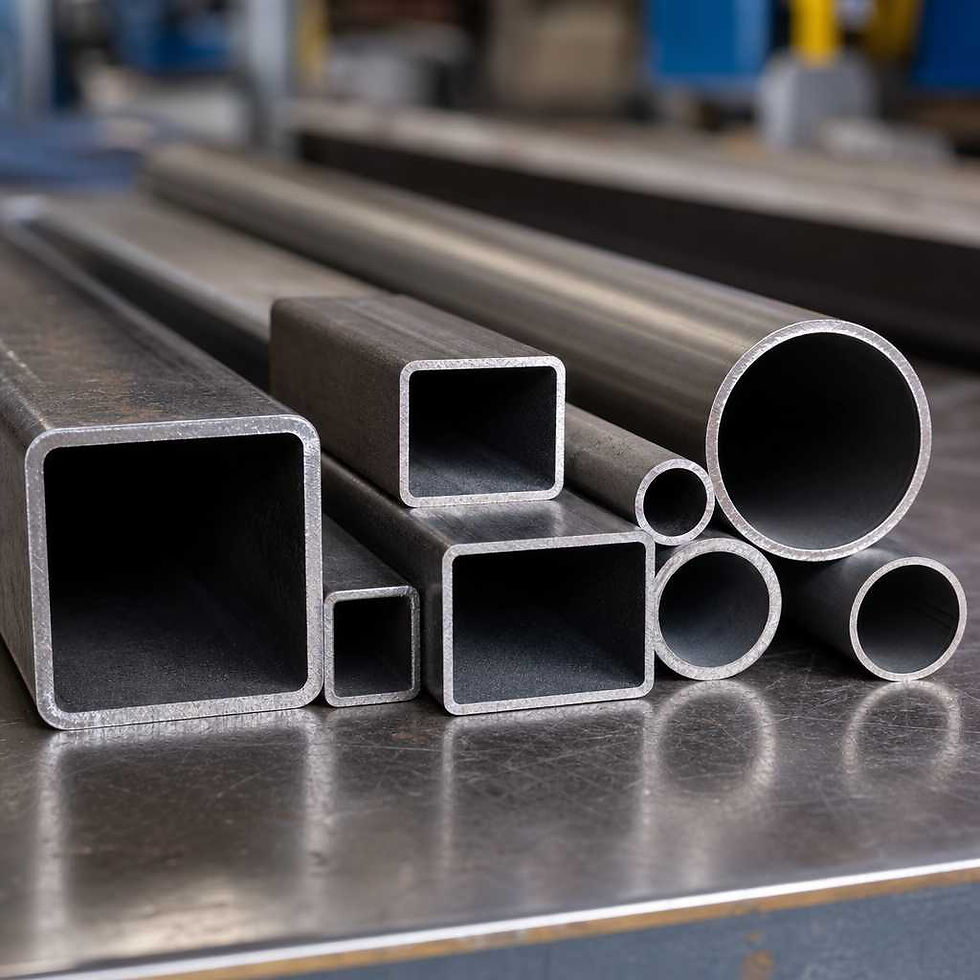
Hollow structural sections are steel profiles with a hollow cross-section, manufactured specifically to carry structural loads in compression, tension, bending, and torsion. Unlike open sections such as I-beams or channels, HSS encloses its cross-section, which gives it a significantly higher torsional stiffness for the same weight of steel. This is not a theoretical advantage. In practice, it directly affects how designers specify column sections in multi-storey steel frames and how fabricators detail connection nodes.
The three primary cross-section shapes are square hollow sections (SHS), rectangular hollow sections (RHS), and circular hollow sections (CHS). Each behaves differently under load and each suits different connection types. A common mistake among newer fabricators is treating SHS and RHS as structurally equivalent when loaded in a non-principal axis. They are not, and using the wrong section orientation can result in inadequate section modulus for the applied bending.
Hollow sections are produced by two main methods: cold forming from flat strip and hot finishing from seamless or welded tube. The distinction matters for residual stress, corner radius, and the applicable manufacturing standard, whether that is EN 10219 for cold-formed or EN 10210 for hot-finished sections.
">
HSS Types and Profiles Available in the UAE Market
The UAE structural steel market stocks a wide range of HSS profiles, but the depth of stock varies significantly by supplier. What is listed in a catalog and what is sitting in a Dubai warehouse on the day you place an order are often different things. Experienced procurement teams at UAE fabricators know to call and confirm physical stock on any critical profile before finalizing their material schedule.
Square Hollow Sections in the UAE
SHS profiles are the most commonly stocked hollow section in the UAE. Sizes from 40x40x3 up to 400x400x16 are regularly available from well-established stockholders. These sections are the workhorse of UAE construction, used in secondary steel, canopy structures, mezzanine frames, and architectural cladding supports throughout Dubai, Abu Dhabi, and wider GCC projects.
The data consistently shows that SHS in S355J2H to EN 10219 accounts for the majority of hollow section demand in UAE fabrication shops. This makes sense. The grade delivers the yield strength structural engineers need for span-to-depth ratios common in commercial and industrial buildings.
Rectangular Hollow Sections
RHS profiles give engineers the flexibility to orient the stronger axis of the section to match the primary load direction. On portal frame structures and purlins, RHS sections outperform SHS when the applied loads are predominantly in one plane. In practice, RHS from 50x30 up to 500x300 in multiple wall thicknesses should be available from any serious structural steel stockholder in Dubai.
Circular Hollow Sections
CHS profiles are structurally efficient under combined loading and are architecturally preferred for exposed structures, bridges, and space frames. They require cope cutting and profiled end preparation for tube-to-tube connections, which adds fabrication time. CHS is the most demanding profile to fabricate accurately, but for truss structures in airports, stadiums, and long-span roofs, there is no substitute for its structural and visual performance.
Standards and Grades for UAE Projects
The UAE follows international standards for structural steel. Most projects specify compliance with EN 10219 for cold-formed hollow sections or EN 10210 for hot-finished sections. ASTM A500 and A501 are also referenced, particularly on projects with American design codes or North American contractors involved in GCC infrastructure.
For grades, S355J2H is the dominant specification in the UAE structural market. The J2 suffix means the steel has a minimum Charpy impact energy of 27 joules at minus 20 degrees Celsius. In the Gulf climate this may seem irrelevant, but international projects and LNG-related infrastructure in the region do specify cold temperature toughness even in hot climates due to the nature of the stored or processed material.
"Specifying the correct sub-grade of S355 for hollow sections is not pedantic. The wrong sub-grade on a connection-critical node can fail certification, delay a project, and ultimately cost more to remediate than the original material saving." - Structural Steel Design to Eurocode 3, commonly cited guidance in GCC engineering offices
S235 grade hollow sections are available and used in light secondary steel applications. S420 and S460 grades are occasionally specified on high-rise projects to reduce section sizes and overall steel tonnage, but these are not standard stock items and must be ordered with lead time from the mill.
Always request a mill test certificate (MTC) with every delivery. The MTC should confirm chemical composition, mechanical properties, and dimensional compliance. On government and major private developer projects in the UAE, submitting material without a valid MTC will get the delivery rejected on site.
Pro tip: When working with consultants on Dubai Municipality or DEWA-regulated projects, confirm whether they require third-party material inspection at origin in addition to the mill certificate. Some project specifications require an independent inspection agency to witness the mill test before shipment. Asking this question early saves considerable delays at the goods receipt stage.
Common Applications in UAE Construction and Infrastructure
Hollow structural sections are found throughout UAE construction, from the lightest mezzanine floor frames to the heaviest industrial structures. The range of applications is one reason why demand for hollow sections in the UAE has remained consistently strong across construction cycles.
Column and Beam Frameworks
SHS and RHS columns are standard in multi-storey steel frame buildings across the UAE. Their bi-axial symmetry simplifies connection detailing compared to H-section columns, and their closed cross-section makes fire protection application more efficient. On industrial projects in Jebel Ali and KIZAD, large RHS columns in thicker wall grades carry significant axial loads in warehouse and logistics facility frames.
Space Frames and Truss Structures
Long-span roof trusses over airport terminals, exhibition halls, and sports facilities in Dubai and Abu Dhabi are predominantly built from CHS or RHS. The torsional efficiency of hollow sections is particularly valuable in three-dimensional truss geometries where eccentric loading introduces torsion that open sections cannot carry as efficiently.
Architectural and Facade Steel
The UAE's built environment demands exposed structural steel that performs visually as well as structurally. CHS columns and RHS mullions are extensively specified in commercial tower lobbies, retail atria, and canopy structures. Surface finish and dimensional consistency matter as much as structural performance in these applications, which is why procurement teams specify the finish tolerance carefully.

">
Infrastructure and Utility Support Structures
Overhead line supports, cable tray structures, pipe racks, and equipment platforms on oil and gas and utilities projects throughout the GCC rely heavily on RHS and CHS sections. These environments often specify hot-dip galvanized finish, which requires the fabricator to work with hollow sections that have adequate vent holes to prevent explosion during the galvanizing process. This is a fabrication detail that every UAE steel fabricator working on infrastructure must have built into their standard drawings.
HSS vs Other Structural Sections: When to Use Which
Selecting hollow sections over universal beams, channels, or angles is not always automatic. The decision depends on load type, connection method, fire rating requirements, and project budget. Here is a direct comparison of the three main structural section families used in UAE steel fabrication.
Structural Section Type
Best Application in UAE Construction
Key Limitation
Hollow Structural Sections (SHS, RHS, CHS)
Columns, exposed architectural steel, space frames, torsion-loaded members, canopy and cantilevered structures
Internal connection bolts require cut-outs or specialist fitting methods. Higher material cost per tonne than open sections in equivalent grades.
Universal Beams and Columns (UB, UC)
Primary floor beams, heavily loaded columns with moment connections, composite construction with concrete decks
Low torsional stiffness, poor visual finish for exposed steel, requires boxing or casing for fire protection in many scenarios.
Angles and Channels (L, C sections)
Secondary bracing, purlins, girts, light framing, lattice trusses in light industrial buildings
Eccentric loading by default in most connections, low section modulus in bending, not suitable for primary structure in most UAE commercial projects.
In practice, most UAE steel fabrication projects use a combination of all three section types. The structural engineer specifies each based on load requirements, but the fabricator's input on connection efficiency and material availability often shapes the final design during value engineering reviews. UAE fabricators who understand why a hollow section is specified, not just that it is specified, add real value in these conversations.
Fabrication Best Practices for Hollow Structural Sections
Fabricating hollow sections demands a different skill set and setup compared to open sections. The key differences are in cutting, connection design, welding procedure, and quality control. A common mistake in UAE fabrication shops is applying I-beam cutting and fitting routines to hollow sections without adjusting for the closed cross-section geometry.
Cutting and End Preparation
For SHS and RHS, straight cut ends are the starting point. CHS requires profiled cuts for saddle or cope connections in tube-to-tube joints. Profile cutting machines with CNC programming are standard in well-equipped Dubai fabrication shops. Manual profiling of CHS ends introduces fit-up errors that accumulate through a truss and create alignment problems at the final chord connection.
Cold saw cutting produces the cleanest ends for SHS and RHS sections going into bolted or welded base plate connections. Plasma cutting introduces a heat-affected zone that must be ground back for connections requiring full penetration welds.
Welding Procedures for HSS
Pre-qualified weld procedures to EN ISO 9606 or ASME Section IX are required on any UAE project with third-party inspection. For hollow section connections, the weld throat and access angle around the closed perimeter is more restricted than on open sections. This means welding in position is more frequent and welder qualification to positional weld grades is more important.
Preheating requirements for S355 in thicker walls above 16mm must be observed. In the UAE heat, it is tempting to skip preheat on the assumption that ambient temperature is sufficient. The data on this is clear: weld cracking in high-strength hollow section connections is still caused by inadequate preheat even in Gulf conditions when thickness and carbon equivalent values require it.
Connection Design Considerations
Hollow section connections are classified as K, T, Y, and X joints depending on the geometry. Each has different design resistance formulas under Eurocode 3 Part 1-8. A critical point for UAE fabricators is that connection efficiency in hollow section trusses depends on the gap or overlap parameter between chord and brace members. Getting this wrong at the fabrication drawing stage means the connection is either overstressed or requires expensive reinforcing plates.
Pro tip: Build a connection database in your CAD system for your most commonly fabricated HSS joint types. Pre-calculating gap, overlap, and weld length for your standard truss pitches and span ranges saves engineering time on repeat project types, which is particularly valuable for UAE fabricators working on repetitive industrial or logistics facility projects across JAFZA, DIC, and KIZAD.
Sourcing Tubes and Pipes in Dubai: What Fabricators Must Know
Dubai is one of the most competitive markets in the world for structural steel distribution. This works in fabricators' favor for pricing, but it also means the market includes suppliers with varying standards of quality control, documentation, and actual stock depth. Choosing your tubes and pipes supplier in Dubai purely on unit price is a false economy.
Distinguishing Structural Hollow Sections from Pressure Pipe
This distinction is not obvious to all procurement managers, but it matters enormously. Structural hollow sections manufactured to EN 10219 or EN 10210 are tested and certified for structural load-bearing performance. ERW pressure pipes to API 5L or EN 10255 are designed for fluid conveyance under internal pressure. The wall thickness tolerances, weld seam quality requirements, and mechanical properties differ.
Using fluid pipe grade material in structural connections on an engineered project is a non-conformance. It will fail third-party inspection and potentially the final structural audit. Always specify the standard, grade, and sub-grade in your purchase order, not just the size and wall thickness.
What to Confirm Before Placing a Purchase Order
Before committing to any hollow section order in the UAE, confirm physical stock location, not just availability in the supplier's system. Confirm the country of origin and the mill, as some projects restrict steel origin for compliance reasons. Confirm the MTC can be provided with delivery and, on inspection-required projects, confirm that the supplier's quality system supports third-party witness inspection at their warehouse.
Alpine Metals, operating from Dubai since 1983 and serving thousands of clients across the UAE and GCC, maintains physical stock of structural hollow sections and can provide full documentation including mill certificates for each delivery. For fabricators running tight project schedules, that stock depth and documentation capability is a procurement risk that a lower-priced import tender cannot always match.
Material Treatments and Surface Preparation
UAE construction and infrastructure projects expose structural steel to one of the most corrosive environments in the world. Coastal humidity, salt spray, temperature cycling, and in industrial zones, chemical exposure combine to make corrosion protection a structural issue, not just an aesthetic one. Getting the surface preparation and treatment right at the fabrication stage determines the long-term performance of any hollow section structure.
Shot Blasting and Priming
Shot blasting to SA 2.5 is the standard surface preparation for hollow sections that will receive a protective paint system in the UAE. This removes mill scale, weld spatter, and surface contamination to a near-white metal finish that gives the primer coat adequate adhesion. Hollow sections that arrive at site with only a light mill coating and no shot blasting will fail early in coastal Dubai environments, regardless of the topcoat applied over insufficient preparation.
Hot-Dip Galvanizing
For infrastructure applications, particularly utility support structures, cable management frames, and outdoor platforms, hot-dip galvanizing gives structural hollow sections a zinc coating that provides both barrier and cathodic protection. The critical fabrication requirement for galvanizing HSS is adequate vent holes at the highest and lowest points of each enclosed section to allow zinc flow and steam escape. Without these, the process creates explosive pressure inside a sealed hollow section. This is a safety issue and a quality issue simultaneously.
Hollow section sizes above approximately 200x200 should have vent holes of at least 12mm diameter. Your galvanizing contractor should specify their requirements in writing. Build this into your fabrication drawings from day one.
Powder Coating and Specialist Finishes
Architectural hollow sections on exposed facades and interior structures in UAE commercial and hospitality projects frequently require powder coating or specialist paint systems for visual finish. The hollow section's smooth surface is well-suited to these finishes, but surface preparation to the paint system manufacturer's specification must be met. Inadequate anchor profile on a smooth RHS surface will cause powder coat adhesion failure within 12 to 18 months in Gulf conditions.
">
Frequently Asked Questions
What is the difference between EN 10219 and EN 10210 hollow sections?
EN 10219 covers cold-formed welded structural hollow sections. These are formed from flat strip at room temperature and then welded along the seam. EN 10210 covers hot-finished structural hollow sections, which undergo further heat treatment after forming to relieve residual stresses and improve dimensional tolerances. Hot-finished sections to EN 10210 have tighter corner radii, more uniform material properties throughout the section, and lower residual stress, making them preferred for complex connection geometries and heavily loaded nodes. For most standard UAE construction applications, EN 10219 S355J2H is adequate and more readily stocked in Dubai.
Can I use the same hollow sections for both structural framing and mechanical pipe applications?
Not on any engineered or inspected project. Structural hollow sections to EN 10219 or EN 10210 and mechanical or pressure pipes to standards like EN 10255 or API 5L are different products manufactured to different specifications. Structural sections are tested and certified for load-bearing performance under bending, compression, and torsion. Using pressure pipe in a structural connection is a non-conformance that will be flagged in third-party inspection and can invalidate your structural warranty. Always specify the correct standard and confirm it on the mill test certificate.
What grade of steel should I specify for hollow sections on a typical UAE commercial building project?
S355J2H to EN 10219 is the correct default for structural hollow sections on UAE commercial and industrial projects. It delivers a nominal yield strength of 355 MPa with guaranteed impact toughness at minus 20 degrees Celsius. S235 is under-specified for primary structure in most applications and should be limited to very light secondary members. S420 and S460 are valid for high-load or weight-sensitive designs but are not standard stock items in Dubai and require mill orders with lead times of 8 to 14 weeks typically.
How do I ensure my hollow section order arrives with full documentation for a third-party inspected project?
Specify your documentation requirements in the purchase order, not after delivery. At minimum, require a mill test certificate per heat number confirming grade, chemical composition, mechanical test results, and dimensional compliance to the applicable standard. For projects requiring third-party inspection, specify this in the PO so the supplier can arrange witness inspection at source or at their warehouse before dispatch. Suppliers who have been operating in the UAE market for decades and who serve major infrastructure and commercial projects will have these systems in place. Suppliers who cannot support this level of documentation should not be used on inspection-critical projects regardless of their price offer.
What are the most common mistakes UAE fabricators make with hollow section connections?
The three most consistent mistakes are: not accounting for the gap or overlap parameter in K and N joints when preparing fabrication drawings, resulting in connection geometries that fail Eurocode checks during the inspection submittal; using cold saw cut ends without grinding on full-penetration weld connections, where the cut surface must meet specific roughness and squareness requirements; and omitting vent holes in sections going for hot-dip galvanizing, which is both a quality failure and a safety hazard. A fourth very common error is specifying the wrong section orientation for RHS members under predominantly uniaxial bending, losing the intended structural efficiency of the rectangular profile.
How does the UAE climate affect the choice of corrosion protection for hollow sections?
Dubai and the broader UAE coastline present one of the most aggressive corrosion environments for structural steel anywhere in the world, combining high humidity, airborne chlorides from the sea, UV exposure, and temperature extremes. For external structures, a minimum three-coat paint system on a shot-blasted substrate or hot-dip galvanizing is required. Internal surfaces of sealed hollow sections are protected by the sealed environment, but any trapped moisture at fabrication stage accelerates internal corrosion. For immersed or below-grade applications, specialist coating systems combined with cathodic protection should be specified. This is not a decision to leave to the painting subcontractor alone, it must be part of the original structural specification.
If you are sourcing hollow structural sections for a UAE project and want to discuss stock availability, grades, or material treatment options, share your experience or questions below and we will respond directly.
We would love your feedback and any insights you would share with others. What perspective would you add?


Comments