
Steel Pipes UAE Oil Gas: Role in Industrial Projects
The UAE moves roughly 3 million barrels of crude oil per day, and every barrel travels through steel pipe at some point in its journey. Yet procurement teams and fabricators across Dubai and the wider GCC routinely underestimate how much a wrong pipe specification decision can cost a project in delays, rework, and regulatory non-compliance. Whether you are sourcing for a refinery expansion in Abu Dhabi, a water-injection system in Oman, or a process plant in Jubail, understanding steel pipes UAE oil gas requirements is not optional background knowledge. It is the difference between a project that runs on schedule and one that stalls at inspection.
Table of Contents
Quick Takeaways
Key Insight
Explanation
API 5L is non-negotiable for hydrocarbon transport
Any line pipe carrying crude oil, natural gas, or refined products in the GCC must meet API 5L Grade B minimum. Anything below this will fail ADNOC, ARAMCO, or PDO contractor audits.
ASTM A106 Grade B covers most process plant needs
For high-temperature, high-pressure process pipework in refineries and petrochemical plants, ASTM A106 Grade B seamless pipe is the practical default specification across UAE industrial zones.
Wall thickness drives project cost more than pipe diameter
Specifying one schedule too high on a bulk order adds 10-25% to material costs with no engineering benefit. Always verify design pressure calculations before locking in schedule.
Local stockholding cuts lead times by 4-8 weeks vs. mill-direct orders
A Dubai-based GCC pipe stockist with ready inventory eliminates sea freight time from Europe or Asia. For fast-track projects, this is a decisive advantage.
Mill Test Certificates must be third-party verified for major clients
ADNOC and EPC contractors on large projects increasingly require SGS or Bureau Veritas third-party inspection. A supplier who cannot facilitate this is a liability.
Corrosion allowance is calculated differently for sour service
H2S-containing environments require NACE MR0175 / ISO 15156 compliance. Standard carbon steel pipes are not adequate without additional material qualification.
Pipe coating selection affects total installed cost significantly
FBE (Fusion Bonded Epoxy) coating adds roughly 8-15% to pipe cost but can reduce cathodic protection system costs by 30-40% over a 20-year pipeline lifecycle.
Why Steel Pipes Are the Backbone of UAE Oil and Gas Infrastructure
The UAE's oil and gas sector accounts for approximately 30% of GDP, according to the UAE Ministry of Energy and Infrastructure. That level of economic dependence means pipelines are not just infrastructure. They are financial arteries. Carbon steel pipe, specifically, remains the dominant material for this work because no other material at scale combines tensile strength, weldability, pressure rating, and cost-effectiveness the way it does.
In practice, the GCC pipe market divides cleanly into two demand categories. The first is upstream, covering wellheads, flow lines, gathering systems, and export lines. The second is downstream and midstream, covering refineries, gas processing plants, petrochemical complexes, water injection systems, and distribution networks. Each category has distinct pipe specification requirements, and a competent industrial pipe supplier Dubai will stock product ranges that serve both without pushing fabricators toward over-specified or under-specified material.
The UAE is currently executing a major expansion of its refining and petrochemical capacity. ADNOC's 2030 strategy targets 5 million barrels per day of production. Every expansion project at Ruwais, Musaffah, or Jebel Ali translates directly into demand for line pipe, process pipe, and structural tubulars. The volume of steel pipe consumed in a single large refinery turnaround can exceed 2,000 metric tons. Procurement decisions made at the start of a project define whether that material is available on time, at the right specification, and with the documentation needed to pass inspection.

Pipe Specifications That Actually Matter for GCC Projects
A common mistake is treating pipe specifications as bureaucratic formalities. They are engineering decisions that carry liability. Getting them wrong does not just mean a failed inspection. It can mean a catastrophic failure in service, and in sour gas service that is a life-safety issue.
API 5L for Line Pipe in Hydrocarbon Service
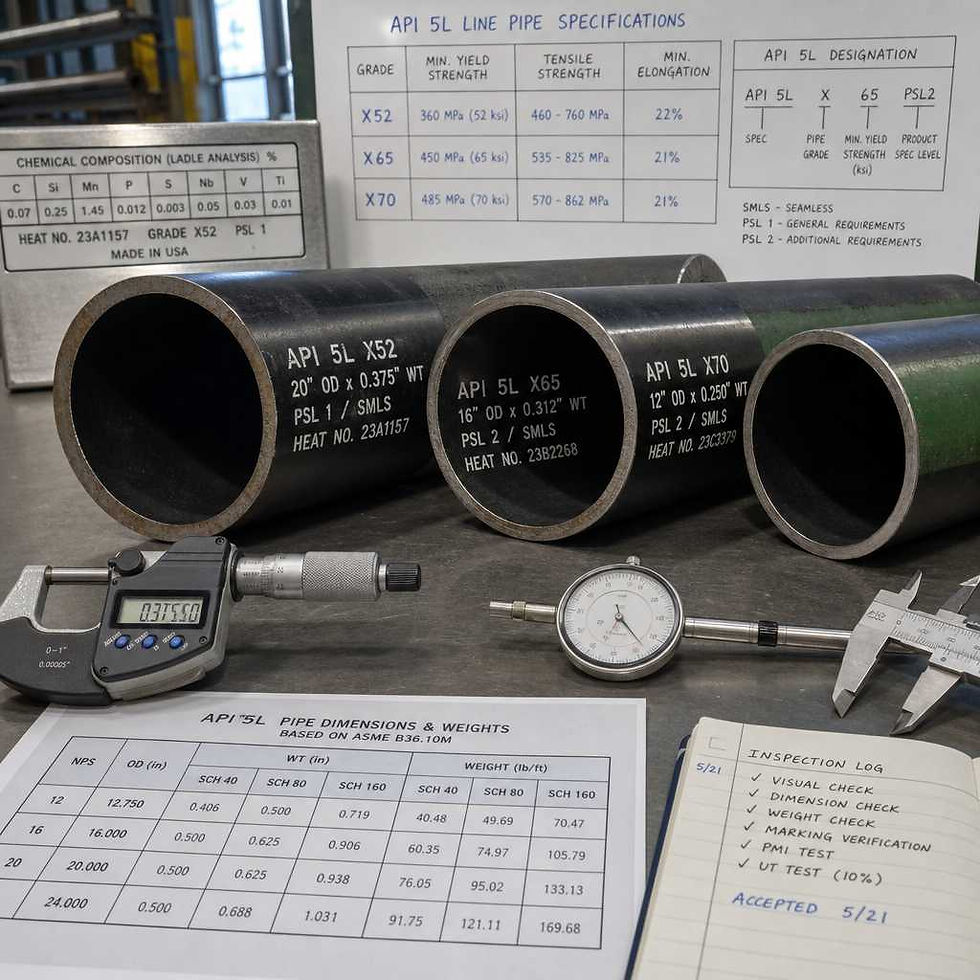
API 5L is the standard for steel line pipe used to transport oil, gas, and water in pipeline systems. The two product specification levels, PSL 1 and PSL 2, differ significantly in their requirements for chemical composition, mechanical properties, and testing. PSL 2 is mandatory for high-pressure gas transmission lines and most offshore applications. The data consistently shows that GCC national oil companies and their approved EPCs require PSL 2 as a minimum on any pipeline operating above 10 bar.
Grade selection within API 5L matters. Grade B covers general service up to moderate pressures. X42, X52, X60, and X65 grades are used progressively as design pressure increases, allowing thinner walls to carry higher loads. X65 and X70 are common in long-distance gas export lines in Saudi Arabia and Qatar.
ASTM A106 and A53 for Process Pipework
Inside process plants, refinery units, and compressor stations, the governing standard shifts to ASTM. A106 Grade B seamless pipe is the workhorse specification for high-temperature service, rated for continuous operation at up to 450 degrees Celsius. ASTM A53 covers both seamless and welded pipe for lower-criticality applications, including utility services and structural applications within industrial facilities.
NACE MR0175 Compliance for Sour Service
Any pipe operating in an environment containing hydrogen sulfide, even in trace concentrations, must comply with NACE MR0175 / ISO 15156. This standard governs material selection to prevent sulfide stress cracking. The hardness limits specified in NACE MR0175 are the controlling factor. Standard API 5L pipe can meet these hardness requirements, but the supplier must confirm compliance with test documentation. This is not something to accept on verbal assurance.
Pro tip: Always request a full Material Test Report (MTR) referencing the specific heat and lot number of the pipe you are purchasing. Generic or retyped MTRs without traceable heat numbers should be refused. Any reputable GCC pipe stockist will provide original mill documentation without being asked twice.
Comparing Pipe Types for Oil, Gas, and Industrial Applications
The three main steel pipe categories used across UAE oil, gas, and industrial projects each have distinct performance profiles, cost implications, and application suitability. Selecting the wrong category wastes money. Understanding where each type genuinely performs is how experienced procurement teams and fabricators maintain project margins.
Pipe Type
Primary Applications in UAE/GCC
Key Advantage vs. Alternatives
Seamless Carbon Steel Pipe (ASTM A106 / API 5L)
Refinery process lines, high-pressure upstream flow lines, compressor stations, critical hydrocarbon service
No weld seam means no seam weld vulnerability under cyclic or high-pressure loading. Preferred by ADNOC and major EPC contractors for critical service. Typically 15-25% more expensive than ERW but eliminates seam integrity risk.
ERW Welded Pipe (API 5L ERW / ASTM A53)
Water injection lines, utility services, gas distribution networks, structural and non-critical process applications
More cost-effective than seamless for medium-pressure service. Modern ERW pipe with ultrasonic seam testing is accepted for a wide range of GCC pipeline applications. Well-suited for large-diameter requirements where seamless is not practically available.
LSAW / SSAW Large Diameter Pipe (API 5L)
Export gas pipelines, water transmission mains, large-bore crude oil gathering lines
Available in diameters up to 1,500mm that seamless cannot achieve. LSAW (Longitudinal Submerged Arc Welded) is preferred over SSAW (Spiral) for high-pressure gas transmission due to its more predictable weld geometry and stress response.
The data consistently shows that for diameters up to 24 inches in critical hydrocarbon service, seamless pipe is specified far more frequently across UAE and GCC projects than ERW. Above 24 inches, LSAW becomes the standard choice. ERW holds a strong position in utility, water, and structural applications where cost control matters more than eliminating weld-seam risk.

What to Demand From an Industrial Pipe Supplier in Dubai
There is a significant difference between a pipe merchant who lists products online and a genuine industrial pipe supplier Dubai with real depth of stock, traceable documentation, and the operational capacity to support large project orders. The GCC project environment is unforgiving about supply chain failures. A delayed pipe delivery on a critical path item does not just cost money. It cascades through the entire project schedule.
Physical Stock Depth and Range
A credible supplier should hold significant physical inventory, not just place orders on receipt. For oil and gas projects specifically, the ability to supply pipes across multiple schedules and grades from a single stockholding location in Dubai or Jebel Ali saves time and reduces procurement complexity. Alpine Metals, operating from its UAE base since 1983, maintains exactly this kind of stockholding model, covering structural steel alongside steel pipes for industrial, oil, gas, and construction clients across the UAE and wider GCC.
Documentation and Traceability Standards
Every pipe supplied for oil and gas service must come with an original MTR, a Positive Material Identification (PMI) result where specified, and a clear heat-number-to-product trace chain. Suppliers who cannot provide this documentation in advance of delivery, or who rely on batch-level rather than heat-level certificates, should not be on your vendor list for critical applications.
Value-Added Services That Save Project Time
Cutting to length, end beveling, shot blasting, and coating application done at the supply stage can eliminate significant on-site fabrication time. A supplier who provides material treatments alongside the supply itself reduces the number of vendor interfaces a project team needs to manage. This is particularly relevant for large pipeline projects where pre-fabrication efficiency directly affects erection schedule.
Pro tip: When evaluating an industrial pipe supplier in Dubai for a major project, ask for a reference list of clients in the UAE oil and gas sector and cross-check it against the supplier's stated mill approvals. A supplier approved by ADNOC's vendor list carries a verification burden that generic pipe merchants simply do not have to meet.
Common Procurement Mistakes That Derail GCC Projects
In practice, most procurement failures on GCC oil and gas pipe contracts come from a small number of repeated errors. None of them are mysterious. They are predictable, and they are avoidable.
The first and most costly mistake is specifying the pipe grade based on what is cheap and available rather than what the design requires. Substituting API 5L Grade B for X52 in a medium-pressure gas gathering system because Grade B is in stock is not conservative engineering. It typically means thicker walls to compensate for lower yield strength, which drives up material weight, welding time, and cost per joint.
The second mistake is accepting pipe without reviewing the MTR before delivery. A common scenario in fast-track projects is that pipe arrives on site, is partially installed, and then fails inspection because the MTR shows a chemistry or hardness value that does not meet the applicable standard for that service. The cost of removing and replacing installed pipe is multiples of what a pre-delivery document review costs.
The third mistake is choosing a supplier based solely on unit price rather than total landed cost. A cheaper price per meter from a supplier without local stock means adding 6-10 weeks of sea freight transit from a European or Asian mill. On a fast-track project, the penalty cost of that delay will exceed the price difference many times over. A reliable GCC pipe stockist with Dubai inventory at a slightly higher unit price is the commercially correct decision for time-sensitive work.
"The quality of a pipeline is determined not just by the pipe itself, but by the consistency of the supply chain behind it. A single non-conforming joint in a critical line can compromise an entire system." - American Petroleum Institute, API 5L Pipeline Transportation Systems documentation
How to Evaluate a GCC Pipe Stockist Before You Commit
Selecting a GCC pipe stockist for an oil and gas project is a risk management decision as much as a commercial one. The questions you ask before signing a purchase order determine whether your project runs smoothly or hits a documentation, delivery, or quality crisis at the worst possible moment.
Verify Mill Approvals and Vendor List Status
The major national oil companies in the region, including ADNOC, Saudi Aramco, and PDO, maintain approved vendor lists (AVLs) that cover both mills and stockists. Being on an AVL requires demonstrated quality system compliance, and it requires regular re-auditing. A stockist who is not on the relevant AVL for your end client creates a supply chain non-conformance that will need to be resolved before material can be installed. Verify AVL status before any other commercial discussion.
Assess Stock Turnover and Freshness
A stockist who holds large quantities of slow-moving pipe is not necessarily a better source than a high-turnover specialist. Old stock, particularly in humid coastal environments like Dubai or Jebel Ali, accumulates surface corrosion that may need to be addressed before the pipe is acceptable for service. Ask when the stock was received, confirm it has been stored correctly, and verify that the MTRs date to the actual material you are buying, not a previous batch with the same nominal specification.
Logistics and Regional Reach Across the GCC
A Dubai-based supplier with genuine GCC delivery capability is materially different from one who supplies only within the UAE. Projects in Saudi Arabia, Oman, Kuwait, or Qatar require export documentation, country-specific certification, and often specific paint or coating standards. Alpine Metals, with decades of GCC-wide distribution experience, handles these logistics as standard, which matters enormously when your project site is in a remote location in Saudi Arabia or Oman and you need pipe on a tight schedule.
The companies who make procurement work smoothly on major oil and gas projects are not the ones who simply list the most products. They are the ones who can confirm stock availability, produce clean documentation, arrange third-party inspection if required, and deliver to the project location on a defined timeline. That combination of capabilities is rare enough to be genuinely valuable, and it is the standard that distinguishes a serious industrial pipe supplier from a commodity trader.
Frequently Asked Questions
What pipe standard is most commonly required for UAE oil and gas projects?
API 5L is the primary standard for line pipe in UAE oil and gas projects. Most ADNOC and EPC contractor specifications require API 5L PSL 2 for any pipeline in hydrocarbon service. For process plant pipework inside refinery and petrochemical facilities, ASTM A106 Grade B seamless pipe is the dominant specification. Both standards are routinely stocked by established industrial pipe suppliers in Dubai.
What is the difference between seamless and ERW pipe for oil and gas service?
Seamless pipe is manufactured without a weld seam, making it preferred for high-pressure, high-temperature, and critical hydrocarbon service where seam integrity must not be a variable. ERW (Electric Resistance Welded) pipe is formed from strip steel and welded longitudinally. Modern ERW pipe with full-body ultrasonic testing is accepted for medium-pressure and utility applications in the GCC. For critical upstream and refinery service, seamless remains the standard choice and is specified far more frequently by major oil companies.
How does sour service affect pipe specification for GCC projects?
Sour service environments contain hydrogen sulfide, which causes sulfide stress cracking in steel that does not meet NACE MR0175 / ISO 15156 hardness and chemistry requirements. Pipe for sour service must be specifically qualified to this standard, and the supplier must provide MTRs confirming compliance. It is not sufficient to assume that API 5L pipe meets sour service requirements. The hardness limit in NACE MR0175 is 22 HRC maximum, and this must be documented per heat lot.
Why should I use a Dubai-based GCC pipe stockist instead of ordering mill-direct for a UAE project?
Mill-direct orders from European or Asian mills typically carry 8-14 week lead times from order placement to delivery at a UAE site, not including inspection and shipping delays. A GCC pipe stockist with ready inventory in Dubai or Jebel Ali can deliver within days or weeks. For fast-track projects, turnaround projects, or projects where scope changes affect pipe requirements mid-execution, local stockholding is the only practical solution. The unit price premium over mill-direct is almost always justified by the schedule certainty.
What documentation should I require with any pipe supply for oil and gas service?
As a minimum, you should require an original Mill Test Report referencing the specific heat number of the material supplied, a dimensional inspection certificate, and confirmation of the applicable standard and product specification level (for API 5L pipe). For sour service, NACE MR0175 compliance documentation is required. For clients who specify it, a Positive Material Identification (PMI) test result and a third-party inspection certificate from SGS, Bureau Veritas, or equivalent should be added. Never accept batch-level or non-traceable documentation for critical service pipe.
What pipe sizes are most commonly needed for UAE industrial and oil and gas projects?
For upstream flow lines and gathering systems, sizes from 2 inches to 12 inches NPS in various API 5L grades are the most common requirements. Refinery and petrochemical process pipework spans a broader range, from half-inch instrument lines to 24-inch main headers. Large-diameter transmission lines and water injection mains typically run from 16 inches to 48 inches. A well-stocked Dubai industrial pipe supplier will hold inventory across this full range rather than being limited to the most common sizes.
If you work in procurement, project management, or fabrication for the UAE or GCC market, share your experience with pipe specification challenges or supply chain problems in the comments below. Your insights could directly help others navigating similar decisions.
We would love your feedback and any insights you would share with others. What perspective would you add?


Comments