
Structural Steel Dubai: High-Rise Construction Guide
The UAE now has more than 25 buildings exceeding 300 metres in height, and that number keeps climbing. For contractors managing high-rise projects in Dubai and across the GCC, the choice of structural steel Dubai suppliers, grades, and connection systems directly determines whether a project finishes on schedule and within code compliance. Get those decisions wrong and you face costly rework, municipal hold-ups, and material wastage that erodes margins fast. This guide cuts through the noise and gives you the technical and sourcing intelligence you actually need on the ground.
Table of Contents
Quick Takeaways
Key Insight
Explanation
Grade selection drives everything
S355 and S460 are the go-to grades for high-rise columns and beams in the UAE. Using S275 where S355 is required wastes material and fails code checks.
Lead times are not negotiable
Imported structural sections can take 8-14 weeks from mill order to Dubai port. Plan procurement before design freeze, not after.
Corrosion protection is not optional
The UAE coastal environment accelerates corrosion dramatically. Hot-dip galvanising or a multi-coat paint system is mandatory for exposed structural elements.
Dubai Municipality approval requires certified material
Mill Test Certificates (MTCs) must match the ESMA and BS EN standards referenced in your structural drawings. Substitutions without re-approval cause delays.
Composite decking reduces overall dead load
Combining structural steel beams with composite floor decking cuts concrete volume by up to 30 percent, lowering foundation loads on high-rise floors.
Stock availability beats price in a fast programme
A supplier with ready UAE stock saves more money in avoided programme delays than a cheaper mill offer with a 10-week lead time.
Fabricator coordination starts at procurement
Steel fabricators in Dubai need exact section lists and tolerances early. Misalignment between the structural engineer's drawing and the purchased section wastes cutting time and material.
Why Structural Steel Dominates UAE High-Rise Projects
Reinforced concrete held the early dominance in UAE construction, but the market has shifted decisively toward structural steel for towers above 20 storeys. The reason is straightforward: steel delivers a far better strength-to-weight ratio, which matters enormously when foundation costs in Dubai's coastal soil conditions are already high.
The data consistently shows that a steel-framed high-rise can be erected at roughly two to three floors per week under an optimised programme, compared to one floor per week for conventional concrete pours. That speed advantage translates directly to earlier handover and lower financing costs, which developers in the UAE value intensely.
In practice, the most successful contractors on projects like mixed-use towers in Business Bay and commercial blocks in DIFC are using construction steel UAE supply chains built around pre-qualified stockholders rather than ad-hoc mill orders. The ability to pull stock at short notice when design revisions require section changes is worth more than marginal price savings.

">
Pro tip: Engage your structural steel supplier during the design development stage, not at tender. A supplier like Alpine Metals with four decades of UAE market experience can flag section availability issues before they become programme risks.
Steel Grades and Specifications for UAE Contractors
Specifying the right steel grade is not a paperwork exercise. It determines section sizes, weld procedures, fabrication complexity, and ultimately the building's performance under seismic and wind loads. The UAE sits in a region with moderate seismic activity and extremely high wind loading on tall structures, so grade selection carries real structural consequence.
S355 vs S460: Which Grade for Which Application
S355JR and S355J2 remain the workhorse grades for columns, beams, and bracing in the majority of UAE high-rise projects. They offer a minimum yield strength of 355 MPa, strong weldability, and broad section availability across the GCC supply chain.
S460 has grown in adoption for heavily loaded transfer structures and outrigger systems in super-tall buildings above 50 storeys. The higher yield strength allows engineers to reduce section sizes, cutting steel tonnage. But S460 demands tighter preheat controls during welding and more experienced fabricators. A common mistake is specifying S460 to save steel tonnage without budgeting for the additional fabrication cost and the narrower local supply base.
Flat Products vs Long Products in High-Rise Framing
Contractors often conflate long products and flat products, but the distinction matters for procurement. Long products, including universal beams, universal columns, angles, and channels, form the primary framing. Flat products, including plates and sheets, are used for connection details, base plates, and fabricated elements.
Alpine Metals supplies both product families from UAE stock, which eliminates the common problem of beams arriving on site weeks before the plates needed to complete the connections. Mismatched deliveries are one of the most avoidable causes of on-site delays in UAE high-rise steel erection.
Hollow Sections for High-Rise Cores and Columns
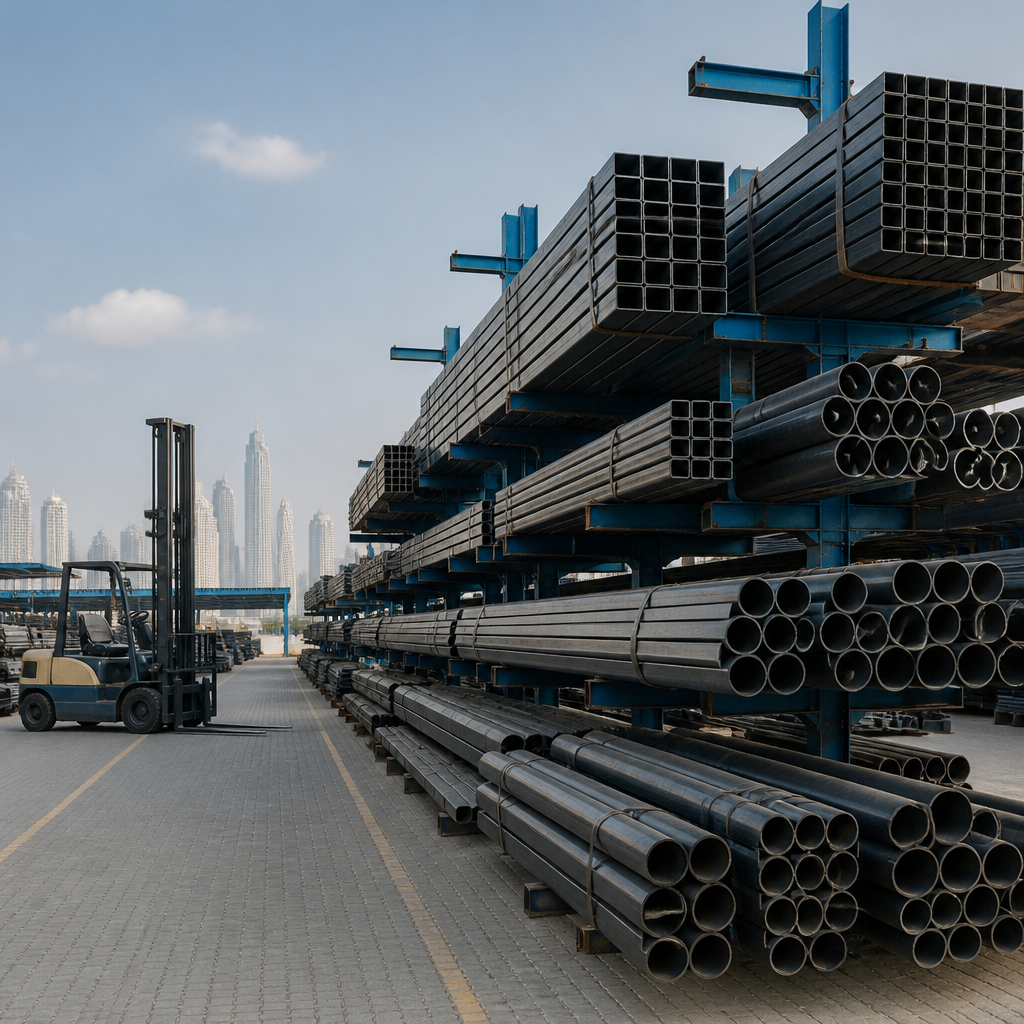
Circular Hollow Sections (CHS) and Rectangular Hollow Sections (RHS) are increasingly specified for exposed architectural columns and for braced core systems. They offer superior torsional resistance compared to open sections and are popular for the aesthetic requirements of Dubai's premium commercial and residential towers.
The key procurement consideration for hollow sections is that wall thickness availability in UAE stock can be limited for large-diameter CHS above 400mm. Plan those sections early and confirm availability before drawing issue.
Structural Systems Compared
High-rise structural steel in the UAE is not a single system. The choice between moment frame, braced frame, and core-and-outrigger systems fundamentally changes the steel tonnage, the fabrication complexity, and the construction sequence. Below is a direct comparison of the three primary systems used on UAE high-rise projects.
Structural System
Best Application in UAE Context
Key Trade-offs
Steel Moment Frame
Mid-rise commercial buildings up to 30 storeys where open floor plates without diagonal bracing are required
Higher steel tonnage, heavy beam-column connections, significant welding on site, but maximum architectural flexibility
Concentrically Braced Frame (CBF)
Industrial and logistics high-rises, car park structures, buildings where diagonal bracing in facade bays is acceptable
Lower steel tonnage, faster erection, simpler connections, but diagonals restrict window and facade layout
Core and Outrigger System
Super-tall residential and mixed-use towers above 40 storeys in Dubai and Abu Dhabi
Highly efficient for extreme height, but requires precise coordination between concrete core construction and steel outrigger erection, demanding a tightly integrated programme
In practice, the core-and-outrigger system has become the default for towers in the 50-to-100 storey range in the UAE. The Burj Khalifa set the template and subsequent tower projects in Dubai have refined the construction methodology significantly.
"The shift toward higher-strength steel grades in UAE tower construction has reduced steel tonnage per floor by 15-20 percent on leading projects over the past decade, directly improving project economics." -- Emirates Green Building Council, UAE Construction Industry Report
Pro tip: On core-and-outrigger projects, lock in the outrigger plate steel and connection hardware procurement no later than the piling stage. These items are often long-lead and fabricator-specific. Missing them stalls erection when the concrete core reaches outrigger level.

">
Procurement and Supply Chain Realities
The UAE structural steel market is supplied through a mix of locally stocked distributors and direct mill imports from Europe, Turkey, and East Asia. Understanding which source is appropriate for your project type is not optional knowledge for a competent procurement manager.
When to Use a UAE Stockholder vs Direct Mill Order
For projects with standard section requirements up to 5,000 tonnes of steel, a UAE-based stockholder with broad stock coverage is almost always the better choice. You get shorter lead times, payment flexibility, the ability to phase deliveries to match the erection programme, and local technical support when drawing queries arise.
Direct mill orders make economic sense above approximately 8,000-10,000 tonnes where the volume justifies the minimum order quantities, the extended lead time, and the working capital tied up in advance payment. Even then, experienced contractors keep a top-up arrangement with a local stockholder for the inevitable design changes and additional quantities.
The True Cost of Chasing the Cheapest Tonne
A common mistake seen repeatedly on UAE projects is awarding the structural steel supply based on the lowest cost per tonne without factoring in the full programme cost of late or incomplete deliveries. A saving of AED 50 per tonne on 3,000 tonnes saves AED 150,000. A two-week programme delay on a high-rise project in Dubai routinely costs AED 500,000 or more in preliminaries, tower crane hire, and liquidated damages exposure.
Alpine Metals has operated in the UAE since 1983, which means the procurement team understands local logistics, Dubai Municipality documentation requirements, and the realities of site delivery scheduling in ways that a new market entrant simply cannot replicate.
Material Treatment and Corrosion Protection
The Gulf climate is genuinely hostile to untreated structural steel. High humidity, salt-laden coastal air, and extreme temperature cycling create corrosion rates that are measurably faster than temperate European conditions. Contractors who under-specify corrosion protection on UAE projects are creating expensive future liabilities for their clients and reputational risk for themselves.
Hot-Dip Galvanising for Secondary Steel
For secondary structural steel elements including staircases, mezzanine framing, handrail posts, and roof plant supports, hot-dip galvanising to BS EN ISO 1461 provides the most durable and cost-effective protection. The zinc coating provides both a barrier and sacrificial cathodic protection, making it the right choice for elements that will be difficult to access for maintenance repainting.
Paint Systems for Primary Structure
Primary structural steelwork is typically protected with a multi-coat paint system applied in the fabrication shop. For UAE conditions, the recommended minimum is a zinc-rich primer, followed by an epoxy intermediate coat, and a polyurethane finish coat to a total dry film thickness of at least 200 microns. In coastal zones within 1 km of the sea, increasing the total DFT to 300 microns and specifying a C5-M environment corrosivity category to BS EN ISO 12944 is justified.
The treatment services offered by suppliers like Alpine Metals, applied before despatch from the stockyard, eliminate the need for contractors to manage separate paint sub-contracts and reduce the risk of sections being damaged in transit after treatment.
Compliance with UAE Standards and Local Codes
The UAE structural steel sector operates under a combination of ESMA (Emirates Authority for Standardisation and Metrology) standards, Dubai Municipality requirements, and internationally recognised codes including BS EN (Eurocodes) and ASTM standards. Getting the compliance documentation right is not bureaucratic box-ticking. It is the difference between a project that passes inspection and one that gets suspended pending material verification.
Mill Test Certificates and Traceability
Every tonne of high-rise construction steel supplied to a UAE project should be accompanied by a Mill Test Certificate that is traceable to a specific heat number and that confirms the chemical composition and mechanical properties meet the specified standard. Dubai Municipality structural inspectors routinely request MTCs during inspections, and an inability to produce them can result in a hold on further erection.
The practical implication for procurement is that buying from a supplier who maintains full MTC traceability from mill to delivery, as Alpine Metals does as standard practice, eliminates a significant compliance risk from your project.
Third-Party Inspection and Testing
For projects requiring third-party inspection, appointing a DACAS-accredited inspection body to witness material testing at the mill or to carry out incoming inspections at the Dubai stockyard is good practice. Ultrasonic testing of welds and dimensional checks on received sections should be written into the quality plan, not treated as optional extras triggered only when problems emerge.
The cost of a structured material inspection programme on a 5,000-tonne structural steel package is typically less than 0.5 percent of the steel supply cost. The cost of a structural defect discovered during construction or, worse, after completion is orders of magnitude higher.
Frequently Asked Questions
What steel grade should I specify for columns in a Dubai high-rise above 30 storeys?
For columns in buildings above 30 storeys, S355J2 or S460ML are the most commonly specified grades in the UAE. S355J2 offers reliable weldability and broad local availability. S460ML provides higher yield strength with good notch toughness, making it suitable for heavily loaded transfer columns and outrigger connections. The final choice depends on your structural engineer's section optimisation, but both grades are regularly stocked by established UAE suppliers.
How long does structural steel procurement typically take in the UAE?
For standard sections available from UAE stockholder stock, delivery to site can be arranged within 1-2 weeks. For non-standard sections or large-volume mill orders, lead times from European or Turkish mills run 8-14 weeks from order confirmation to arrival at Dubai port, plus 1-2 weeks for customs clearance and delivery. Always confirm current stock availability before finalising your procurement programme.
What are the key differences between buying structural steel from a UAE stockholder versus importing directly from a mill?
A UAE stockholder offers shorter lead times, smaller minimum order quantities, phased deliveries, local technical support, and full MTC documentation ready on hand. Direct mill imports are more economical at high volumes above 8,000-10,000 tonnes but require longer lead times, larger upfront commitments, and the contractor takes on more logistics and documentation responsibility. For most UAE high-rise projects, a combination of both approaches works best.
Are UAE structural steel suppliers able to provide material treatment services, or do contractors have to manage that separately?
Established UAE suppliers including Alpine Metals offer integrated material treatment services such as cutting, drilling, shot blasting, and painting as part of their supply package. This significantly simplifies project management because it removes the need to coordinate a separate treatment sub-contractor and reduces the risk of material damage between supply and treatment. Always clarify the scope of treatment services at enquiry stage.
What corrosion protection specification is appropriate for structural steelwork within 500 metres of the Dubai coastline?
For structures within 500 metres of the coast, a C5-M corrosivity category to BS EN ISO 12944 is the correct starting point. The recommended paint system is a zinc-rich epoxy primer at minimum 60 microns DFT, an epoxy intermediate coat at 100 microns, and a polyurethane topcoat at 60 microns, giving 220 microns total. For elements that will be submerged or in direct splash zones, hot-dip galvanising plus an additional paint system is the conservative and recommended approach.
How do I verify that structural steel delivered to my UAE project meets the specified standard?
Request Mill Test Certificates for every delivery, cross-reference the heat numbers on the MTCs against the markings on the sections, and confirm that the reported yield strength, tensile strength, and elongation values meet the minimum requirements of the specified standard such as BS EN 10025 for S355. For high-value or high-risk connections, arrange independent tensile testing at a UAE accredited laboratory as a further verification step.
If you are currently working on a UAE high-rise steel project or planning procurement for an upcoming tender, share your biggest supply challenge in the comments below and we will address it directly.
We would love your feedback and any insights you would share with others. What perspective would you add?

Comments