
Structural Steel Products Dubai: What to Stock
If your construction company operates in Dubai and you have ever had to halt a pour, delay a frame erection, or pay premium spot-market rates because a specific steel section was not on hand, the problem usually traces back to the same root cause: poor stock planning. Structural steel products in Dubai are not in short supply, but the right profile, in the right grade, cut to the right length, available the same week you need it - that combination is rarer than it should be. This guide tells you exactly which products every serious construction and fabrication company should be holding in inventory, why each one matters, and how to think about sourcing them from a reliable steel stockist in Dubai.
Table of Contents
Quick Takeaways
Key Insight
Explanation
Universal Beams (UB) are non-negotiable stock items
Every multi-storey frame, mezzanine, or portal structure in Dubai needs UBs. Running out mid-project means expensive delays.
SHS profiles are the most commonly stocked hollow section in the UAE
Sizes from 40x40x3 up to 400x400x16 are regularly available from established UAE stockholders and cover most secondary steel needs.
Grade matters more than price per tonne
Mixing up S275 and S355 on a structural project is not a minor procurement error - it is a structural integrity issue that can fail inspection.
EN 10025 is the dominant standard in Dubai and the GCC
S275JR and S355JR under EN 10025 are what most Dubai engineers specify. Stock to this standard to avoid grade substitution headaches.
Structural angles serve more roles than most buyers realise
Equal angles (L-sections 25x25 to 200x200mm) cover bracing, trusses, connections, shelving, and general fabrication - one profile with many applications.
Mill Test Certificates (MTCs) are mandatory, not optional
Any reputable steel stockist in Dubai must supply EN 10204 Type 3.1 or 3.2 MTCs with every structural shipment. Never accept product without them.
Hollow sections: hot-formed vs cold-formed affects weldability
Cold-formed RHS and SHS have tighter corner radii, limiting weld access in gusset plate connections. Specify hot-formed for heavy fabrication work.
Why Your Stocking Strategy Matters More Than Price Per Tonne
Construction companies in Dubai often benchmark their steel procurement almost entirely on price per tonne. That is the wrong metric to optimise for. The real cost driver is schedule risk - and schedule risk is a direct function of whether the steel section you need is available when your programme demands it.
Dubai's construction market has been running at high intensity. Construction and transport contract awards in Dubai had reached approximately $17.8 billion by late 2023, tracking close to the record highs seen in 2018. Major infrastructure commitments - from airport expansion to road upgrades - mean that demand for construction steel UAE-wide is not easing up. When the market is busy, spot availability tightens. Companies that stock strategically do not have to scramble.
The answer is not to warehouse everything. It is to identify the specific structural steel products that appear in your project pipeline repeatedly and maintain working stock of those profiles and grades. Every item below earns its place on that list for a concrete reason.
Pro tip: Before placing any steel order, cross-reference your structural drawings against your current yard inventory. Most construction companies discover they are overstocked on one or two profiles and critically short on three others. That imbalance is where project delays originate.


Universal Beams and Columns: The Backbone of Every Frame
Universal Beams (UB) and Universal Columns (UC) are the foundation of structural framing. In Dubai's commercial and industrial construction sector, these are the sections specified most frequently by structural engineers, and they are the profiles where procurement errors are most expensive.
Universal Beams (UB / I-Beams)
UBs are designed to carry loads predominantly in one plane, making them the default choice for primary beams, floor beams, and crane runway beams. The designation you order should match the section table exactly - 203x133x25 UB and 203x203x46 UC are not interchangeable despite similar dimensions, and the consequences of mixing them up on site are serious.
In the UAE market, the most commonly specified UB sizes range from 152x89 through to 610x229. Stock the sizes your standard frame designs call for. If you are working on industrial sheds, warehouse structures, or mezzanine decks, the 254, 305, and 356 series UBs will appear on almost every job.
Universal Columns (UC / H-Beams)
UCs are optimised for axial load carrying - they are the column sections that hold everything up. H-beams, as they are commonly called in the GCC market, have a wide, stocky profile that distributes compressive forces efficiently. For multi-storey frames and heavy industrial structures in Dubai, the 203x203, 254x254, and 305x305 UC series are the most frequently specified.
A common mistake among smaller fabricators is treating H-beams and I-beams as substitutes based on visual similarity. They are not. The depth-to-flange-width ratio is fundamentally different, and the structural behaviour under combined axial and bending loads differs accordingly. Order what is specified, and verify with your structural engineer before any substitution.
Specifying the correct section profile the first time eliminates one of the most common and expensive rework scenarios in structural steel fabrication. Grade, profile, and standard must all match the engineer's intent - two out of three is not good enough.
Hollow Structural Sections: RHS, SHS, and CHS Explained
Hollow structural sections (HSS) have become the preferred choice for secondary steelwork, architectural features, canopies, and light industrial structures across Dubai and the wider GCC. Their clean lines appeal to architects, and their closed cross-sections provide efficient resistance to both bending and torsion.
Square Hollow Sections (SHS)
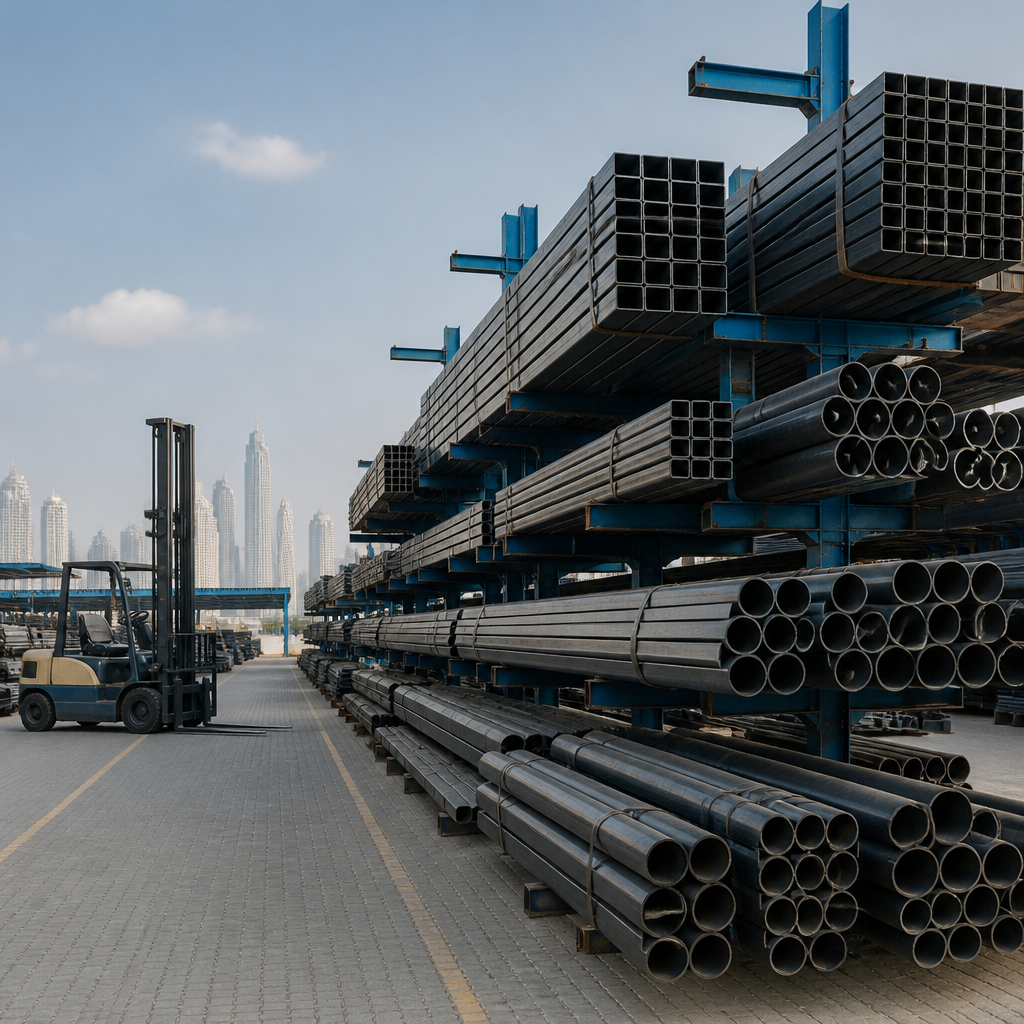
SHS profiles are the most commonly stocked hollow section in the UAE. Sizes from 40x40x3 up to 400x400x16 are regularly available from well-established stockholders. These sections are the workhorse of UAE construction: used in secondary steel, gate frames, canopy structures, handrails, and light columns where aesthetics matter. If you have any regular fabrication volume, SHS should be a permanent item in your stock list.
Rectangular Hollow Sections (RHS)
RHS sections offer a larger range of depth-to-width ratios, which makes them suitable for applications where you need greater bending resistance in one direction - purlins, lintels, and spanning secondary beams are typical examples. RHS features consistent wall thickness, strong weldability, and good resistance to bending and deformation, making it a reliable choice for both structural and industrial needs.
Circular Hollow Sections (CHS)
CHS sections are specified for columns that carry loads equally from all directions, for structural tubes in exposed architectural applications, and for piping that must double as a structural element. They are less universally stocked than SHS or RHS, but for companies working on commercial fit-outs or facade-intensive projects, maintaining a small CHS inventory pays off in schedule reliability.
Pro tip: Always clarify whether a hollow section specification calls for hot-formed (EN 10210) or cold-formed (EN 10219) product. Cold-formed sections have tighter corner radii, which can restrict weld access in gusset plate connections and affect your fabrication productivity. Hot-formed is the safer default for heavy structural work.
Angles, Channels, and Flat Bars: The Unsung Workhorses
Equal angles, unequal angles, channels, and flat bars are what keeps a fabrication shop running smoothly between the major sections. They are also the products most likely to hold up a job when they run out because they are seen as "low-value" stock items that procurement teams habitually underorder.
Equal and Unequal Angles
Equal angles (L-sections from 25x25 to 200x200mm) and unequal angles (from 40x25 to 200x100mm) in EN 10056, ASTM A36, and IS 2062 grades cover bracing, trusses, connections, shelving, and general fabrication. The 50x50, 65x65, 75x75, and 100x100 equal angles are the sizes to prioritise - they appear in almost every structural package regardless of building type.
Parallel Flange Channels (PFC / C-Channel)
The C-channel is one of the most versatile sections in construction steel. It is manufactured from hot-rolled steel and used across bridge decks, secondary beams, purlin systems, and equipment bases. Because it can be easily welded and bolted to other elements, it appears in fabrication packages for industrial, commercial, and infrastructure projects with near-equal frequency. Stock a range of the mid-size PFC sections (100, 125, 150, 180mm) and you will cover the majority of project demands without carrying excess inventory.
Flat Bars
Flat bars are underrated. They serve as stiffeners, connection plates, gusset plates, and packing pieces in structural assemblies. Running out of flat bar mid-fabrication is the kind of problem that should never happen but does constantly when procurement teams treat it as an afterthought. Carry stock in at least 50mm, 75mm, 100mm, and 150mm widths in 6mm and 10mm thickness as a baseline.
Steel Plates and Structural Pipes: Heavy-Duty Staples
For construction companies involved in heavy industrial, infrastructure, or oil and gas adjacent work, steel plates and structural pipes are as fundamental as beams and columns. Their procurement cycle is longer and the unit cost higher, which makes stocking decisions more consequential.
Structural Steel Plates
The two grades you will encounter most frequently in Dubai and Abu Dhabi construction are S275JR and S355JR, both specified under EN 10025. S275 has a minimum yield strength of 275 MPa and is used in general structural applications. S355 reaches 355 MPa and is the preferred grade for heavier structures, crane components, and high-load bearing elements. Ordering the wrong grade is not a procurement inconvenience - it is a structural failure risk.
Plates under 6mm are classified as sheet in standard steel terminology. This distinction matters when you are specifying to a supplier: a plate order that arrives as sheet stock has different tolerances, different handling requirements, and potentially different mechanical properties. Clarify with your steel stockist before order confirmation.
Steel Pipes and Structural Tubes
For companies working on infrastructure, MEP-adjacent structural packages, or any project where fluid-carrying capacity and structural function are combined, steel pipes are a must-have inventory item. Structural pipes in the UAE market are commonly specified in circular form for columns, supports, and exposed architectural applications. Alpine Metals, operating since 1983, supplies a dedicated range of steel pipes alongside structural sections, which means you can consolidate orders and simplify your supply chain rather than splitting procurement across multiple vendors.
Choosing the Right Steel Grade for UAE Construction
Grade selection is where the most expensive mistakes in construction steel procurement occur. The UAE market sees a mix of European, American, and South Asian steel coming through Dubai's ports, and the grade naming conventions are not always immediately obvious to buyers who are not specialists.
The dominant standard in Dubai and GCC structural projects is EN 10025. The S275JR and S355JR designations are what most structural engineers in the region specify by default. For hollow sections, EN 10210 (hot-formed) and EN 10219 (cold-formed) are the applicable standards. ASTM A36, which remains common in projects with American engineering influence, is broadly equivalent to S235/S275 but the exact properties differ - do not treat them as interchangeable without your engineer's sign-off.
For high-load or heavy industrial applications, S420 and S460 grades exist and are stocked by specialist suppliers in the UAE, but they are not everyday stock items for most construction companies. S355 handles the majority of demanding structural requirements in the GCC market without needing to step up to higher-strength grades.
Every shipment of structural steel in the UAE market should arrive with a Mill Test Certificate (MTC) at a minimum of EN 10204 Type 3.1. For projects requiring third-party verification, Type 3.2 certification is standard. Any steel stockist in Dubai that cannot produce these documents on delivery is a supplier you should not be working with, regardless of price.
Comparison: Sourcing Approaches for Construction Steel in the UAE
Not all sourcing strategies deliver the same outcome. Below is a direct comparison of the three main approaches construction companies in Dubai use, and where each one breaks down.
Sourcing Approach
Advantages
Where It Breaks Down
Spot Buying (Multiple Suppliers)
Flexibility to chase lowest price per tonne across vendors. Useful when the market is loose and lead times are long.
No guarantee of grade consistency across suppliers. MTC documentation becomes fragmented. In a tight market, you have no priority with anyone.
Single-Supplier Stockholder Partnership
Consistent grade, reliable MTCs, priority allocation when the market tightens. Can negotiate value-added services (cut-to-length, shot blasting, priming) in one order.
Requires due diligence upfront. A poor choice of stockholder partner is harder to exit mid-project than a one-off spot buy.
Mill Direct Procurement
Best price per tonne on large volumes. Direct traceability on certification. Ideal for major contractors with predictable long-run requirements.
Minimum order quantities are high. Lead times are long (often 8-14 weeks ex-mill). Zero flexibility for project programme changes.
In practice, the most effective approach for mid-size construction and fabrication companies in Dubai is a primary stockholder partnership for core structural sections, supplemented by spot buys for unusual profiles or short-duration requirements. This gives you the schedule reliability and certification quality of a trusted relationship without locking all your volume into a single point of risk.
Frequently Asked Questions
What structural steel products should a Dubai construction company stock as a baseline?
At minimum, stock Universal Beams (UB) and Universal Columns (UC) in the sizes your standard project types call for, Square Hollow Sections (SHS) from 40x40 to 150x150, Equal Angles in 50x50, 75x75, and 100x100, Parallel Flange Channels in 100-180mm range, and flat bars in 50-150mm width. Steel plates in S275JR and S355JR grade round out a functional baseline inventory for most Dubai construction operations.
What is the difference between S275 and S355 structural steel in UAE construction?
S275JR has a minimum yield strength of 275 MPa and is used in general structural applications. S355JR reaches 355 MPa and is specified for heavier structures, crane beams, and high-load bearing elements. Both are under EN 10025, which is the dominant standard for structural steel in Dubai and the GCC. Substituting one for the other requires explicit sign-off from the project's structural engineer - it is never a procurement team decision to make unilaterally.
How do I know if a steel stockist in Dubai is reliable?
A reliable steel stockist in Dubai should provide EN 10204 Type 3.1 or 3.2 Mill Test Certificates with every structural shipment, maintain physical stock (not just act as a trader placing orders with mills), offer clear lead times rather than vague delivery windows, and have experience with the full range of structural sections your projects require. Length of operation in the market is also a meaningful signal - companies that have been trading since the 1980s and 1990s have survived multiple market cycles and client expectations that short-term traders have not.
Is ASTM A36 acceptable for structural steel projects in Dubai?
ASTM A36 is used in Dubai, particularly on projects with American engineering specifications. It is broadly comparable to S235/S275 under EN 10025, but the standards are not identical and the grades should not be treated as directly interchangeable without an engineer's confirmation. Most UAE infrastructure and government projects specify EN grades, so if you are working across multiple project types, EN 10025 stock is the safer baseline to maintain.
What is the advantage of buying structural steel from a stockholder versus ordering direct from a mill?
Mill direct orders offer the best price at large volumes but come with high minimum quantities and lead times of 8 to 14 weeks ex-mill, with no flexibility for programme changes. A Dubai-based stockholder holds physical inventory, which means you can receive material in days rather than months. For construction companies where project timelines are tight or volumes are mixed across multiple profile types, a stockholder provides the schedule reliability and order flexibility that mill direct procurement cannot match.
Do hollow sections need to be hot-formed or cold-formed for structural use in Dubai?
Both hot-formed (EN 10210) and cold-formed (EN 10219) hollow sections are used in structural applications in Dubai. The key difference is in the corner radii and weld access: cold-formed sections have tighter corners that can restrict welding in complex connections. For heavy structural fabrication and gusset plate connections, hot-formed sections are the more practical choice. For lighter secondary steelwork and architectural applications, cold-formed sections perform well and are typically easier to source from local stockholders.
If you are sourcing or stocking structural steel in Dubai, share your biggest procurement challenge in the comments - we would like to know what the market looks like from your end of the supply chain.
We would love your feedback and any insights you would share with others. What perspective would you add?

Comments