
Structural Steel Suppliers UAE: Complete Sourcing Guide
Procurement managers and site engineers in the UAE face the same recurring problem: a supplier who quoted well on a previous job cannot deliver the right grade, the right section size, or the right documentation when the next project demands it. With the UAE steel pipes and tubes market generating approximately USD 1.29 billion in revenue in 2025 and projected to grow at a compound annual rate of 5.7 percent through 2033, the supply landscape is expanding but so is the complexity of choosing the right partner. This guide cuts through that complexity and gives construction companies, steel fabricators, and steel contractors a practical, opinionated framework for sourcing structural steel suppliers in UAE and selecting the right tube and pipe products for every project type.
Table of Contents
Quick Takeaways
Key Insight | Explanation |
|---|---|
Grade substitution is a compliance failure, not a workaround | If a supplier offers a "similar" grade to what your engineer specified, get written re-approval from the engineer of record before accepting delivery. There is no shortcut here. |
Stockholder versus trader determines your lead time | A stockholder physically holds stock in the UAE. A trader sources it upon order. For fast-track projects, the distinction is the difference between a two-day and a six-week wait. |
Mill Test Certificates are non-negotiable | Every structural steel delivery must be accompanied by MTCs traceable to the heat number. A supplier who cannot provide a 3.1 certificate is not an acceptable source for structural applications. |
S355 is the practical default for most UAE structural work | The cost premium over S235 is typically 5 to 8 percent of the steel line item, while the higher yield strength allows smaller sections and lower overall tonnage on the project. |
Steel tubes in the UAE cover three distinct profile types | CHS (circular), SHS (square), and RHS (rectangular) hollow sections each have different structural, fabrication, and connection characteristics. Specifying the wrong type adds rework costs. |
ISO 9001 certification is the minimum quality management baseline | It does not guarantee product quality by itself, but a supplier without it has no documented system for catching non-conformances before they reach your site. |
UAE standards combine ESMA, BS EN, and ASTM requirements | Projects led by European consultants typically specify EN 10025 grades. American-influenced projects use ASTM A36 and A572 Grade 50. Confirm the standard before raising a purchase order. |
The UAE Structural Steel Market: What You Are Actually Buying Into
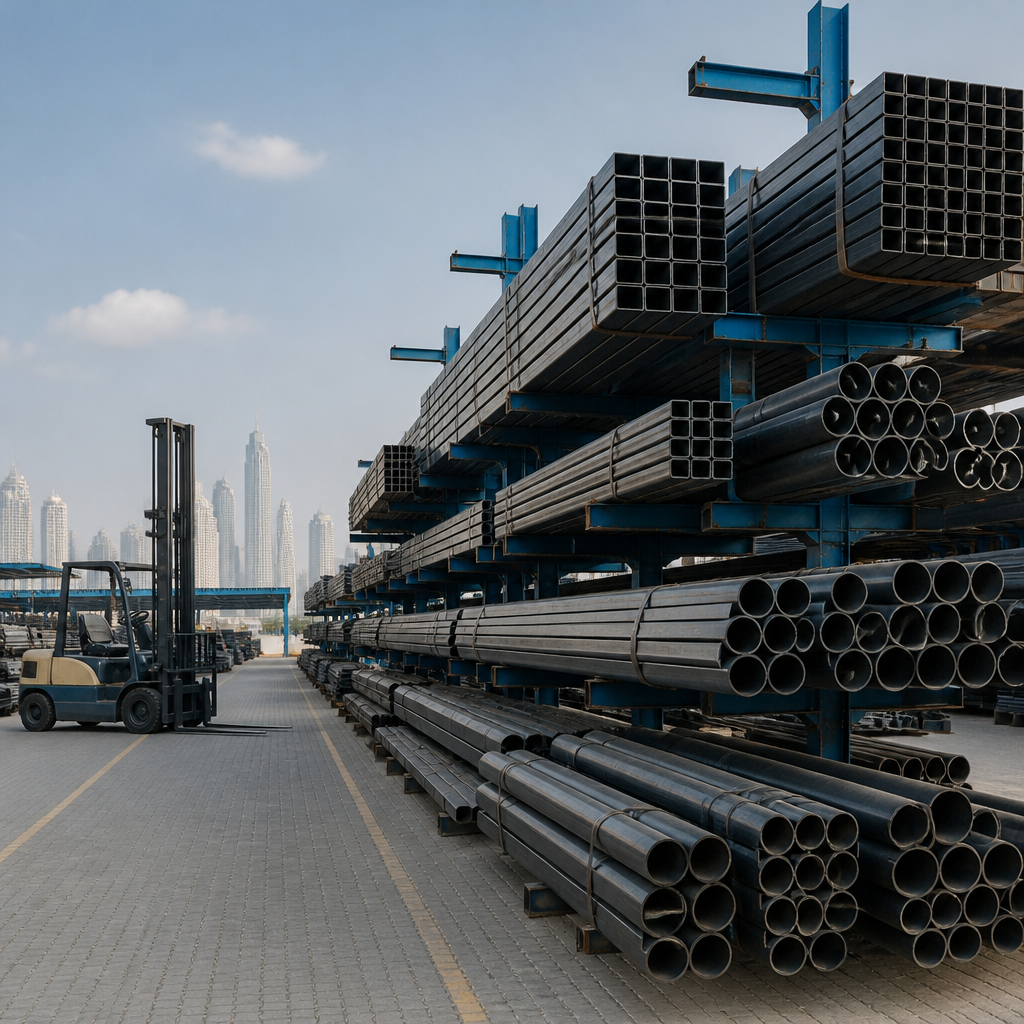
The UAE construction pipeline remains one of the most active in the world, and the steel supply chain that feeds it is large, fragmented, and increasingly specialised. Dubai and Abu Dhabi anchor the majority of demand, but significant project activity in Sharjah, Ras Al Khaimah, and the Northern Emirates means that a supplier with genuine UAE-wide distribution capability is worth more than one whose logistics only extend as far as the nearest Jebel Ali depot.
Understanding the structure of the market is the first step to sourcing intelligently. The UAE steel supply chain runs from primary producers through regional mills and trading intermediaries, down to stockholders and distributors who maintain physical inventory for immediate sale. Each layer of that chain adds cost, but it also adds availability and technical support. The choice of where in that chain to buy depends entirely on your project's volume, lead time, specification complexity, and documentation requirements.
Pro tip: For any project with a fixed programme, always confirm physical stock availability in the UAE before issuing a formal purchase order. A supplier who says stock is "available" but needs to import it on the next vessel is a trader, not a stockholder. The two-week difference that sounds minor at tendering stage becomes a site stoppage when it lands.


Types of Structural Steel Suppliers in Dubai and the UAE
The UAE market has at least four distinct types of entities that describe themselves as structural steel suppliers. Knowing which type you are dealing with changes how you manage procurement risk.
Primary Producers and Regional Mills
Regional steel mills produce long products such as rebar, sections, and tubes. Their structural steel meets international standards and is competitive on price for large-volume orders. The trade-off is that mill orders require minimum quantity commitments and lead times measured in weeks, not days. For mega-projects placing orders in thousands of tonnes, mill relationships are worth building. For the typical commercial building or fabrication shop, direct mill orders are impractical.
Stockholders and Distributors
A stockholder physically holds inventory of structural steel products in the UAE, typically across a range of grades, sections, and surface finishes. This is the most important supplier type for contractors and fabricators who need reliable, fast access to material. A well-stocked distributor operating since the 1980s, for example, will have established mill relationships across Europe, Asia, and the wider region, giving them the flexibility to source hard-to-find sizes without the excessive lead times or cost premiums that come from emergency procurement. When you are evaluating a supplier claiming to be a stockholder, ask them directly: where is the stock physically located right now, and can you inspect it?
Steel Traders and Indenting Agents
Traders do not hold stock. They match buyers with sellers, often sourcing from mills or stockholders in other countries on a per-order basis. They have a role in the market for non-standard or very large orders, but they are a poor choice for fast-track projects or for contractors who need documentation control from mill to site. A common mistake is assuming that a trader's quoted price includes all logistics, duties, and handling. Get a delivered-duty-paid price and compare it to a stockholder's ex-stock price, including the lead time differential.
Steel Service Centres
Service centres stock material and also offer value-added processing: cutting to length, drilling, shot blasting, coating, and sometimes fabrication. For contractors who need processed material rather than raw structural sections, a service centre can eliminate a step in the supply chain and reduce site labour costs. Not every distributor in the UAE offers full processing services, so confirm the scope before treating a service centre quotation as equivalent to a raw material quotation.
Steel Tubes in Dubai and the UAE: Types, Standards, and Selection
Steel tubes are one of the most widely misspecified categories in UAE construction procurement. The range of available products is broad, the terminology overlaps across standards, and a substitution that looks reasonable on paper can fail at the inspection stage. Getting this right from the start saves significant rework cost.
Hollow Section Profiles: CHS, SHS, and RHS
Structural hollow sections in the UAE market are available in three primary profiles. Circular Hollow Sections (CHS) offer the best torsional resistance and are common in column and truss applications where loads come from multiple directions. Square Hollow Sections (SHS) are easy to connect and fabricate, making them the preferred choice for secondary framing, purlins, and modular structures. Rectangular Hollow Sections (RHS) are the most versatile profile, used in everything from portal frames to access platforms and canopy structures across UAE commercial and industrial projects.
For structural hollow sections, EN 10219 (cold-formed) and EN 10210 (hot-finished) are the primary standards. S235, S275, and S355 are the standard yield strength designations. S355J2H is the most commonly specified structural hollow section grade in UAE fabrication. For most structural hollow section applications in UAE construction, S355 is the correct grade: it allows smaller section sizes for the same load, reducing weight and material cost per tonne of structure delivered.
Steel Pipes for Structural and Pressure Applications
The distinction between structural steel tubes and pressure-rated steel pipes matters more than many procurement teams recognise. API 5L Grade B is the entry-level specification for line pipes. ASTM A53 Grade B covers ERW and seamless pipes for general structural and pressure service. EN 10217 governs welded steel tubes for pressure purposes and is widely accepted by UAE consultants on building services projects.
A common and costly mistake is procuring API 5L pipe for a structural support application because it is available in the right outer diameter, without confirming whether the wall thickness and grade match the structural design requirements. The Mill Test Certificate must be verified against the specification, not just against the outer diameter and wall thickness. The engineer of record specifies the standard for a reason.
Pro tip: Always ask your supplier for the actual stock MTC before issuing a purchase order, not a sample certificate. The actual document will confirm the exact heat number, chemical composition, and mechanical properties of the material you are about to receive. If a supplier cannot produce this before delivery, source elsewhere.

How Steel Wholesalers in the UAE Operate and What That Means for Your Lead Times
The term "steel wholesaler" in the UAE covers a wide range of operations, from genuine large-volume stockholders with warehousing capacity measured in thousands of square metres to small trading offices that resell product they do not own. Understanding the difference is not merely academic. It directly determines whether your material arrives in two days or two months.
Genuine steel wholesalers in the UAE maintain physical inventory across a range of structural products, often including long products (beams, columns, angles, channels, flat bars), flat products (plates, coils, sheets), and tubes and pipes. The depth of that inventory varies significantly. A wholesaler with established relationships with multiple mills across Europe and Asia will carry a broader range of section sizes and grades than one sourcing primarily from a single regional supplier.
The quality of a steel supplier relationship is not tested when everything goes smoothly. It is tested when a project programme compresses, a specific section size is hard to find, and the supplier either delivers a solution or a list of reasons why they cannot.
When comparing steel wholesalers in the UAE, lead time is the single most important variable after price and documentation quality. Ex-stock lead times for common structural sections from a genuine UAE stockholder should typically be measured in days. Any lead time described as "subject to vessel availability" or "three to six weeks" means the material is not in the country and the supplier is a trader or indenting agent, regardless of how they describe themselves.
How to Evaluate Structural Steel Suppliers in Dubai Before Placing an Order
The sales conversation before an order is placed is not a reliable indicator of the support you will receive once the purchase order is raised. The evaluation process should be structured, repeatable, and applied consistently across every new supplier relationship.
Seven Criteria That Actually Matter
Physical stock depth in the UAE. Ask for a current stock list, not a product catalogue. A product catalogue tells you what the supplier can theoretically source. A current stock list tells you what is actually on the shelf today.
Mill traceability and MTC quality. A 3.1 certificate is issued by the steel manufacturer's authorised representative and is the standard document for most UAE structural steel applications. Confirm that the supplier can provide this for every consignment, not just for selected items.
ISO 9001 certification. This is a baseline quality management indicator, not a guarantee of product quality. A stockist without it has no documented process for identifying and quarantining non-conforming material before it reaches a construction site.
Grade and specification competence. The person you are speaking to should be able to confirm the yield strength, impact test temperature, and standard designation for any grade you are considering ordering. If the response is vague or requires checking with someone else, the supplier's technical depth is limited.
Standards compliance. Structural steel in the UAE typically needs to comply with EN 10025, ASTM A36, or equivalent standards depending on the project specification. Confirm that the supplier can source and certify material to the exact grade specified, not merely a similar one.
Processing and logistics capability. Does the supplier offer cutting to length, shot blasting, or coating? Can they deliver to your site or fabrication yard on the schedule you need? These practical questions separate a full-service supply partner from a material-only vendor.
Third-party inspection readiness. Suppliers comfortable with third-party inspection have nothing to hide about their material sourcing. If a supplier resists or hedges on this point, treat it as a red flag.
Comparing Supplier Types: A Practical Reference Table
The table below compares the three most relevant supplier types for construction companies and fabricators operating in the UAE. Use it as a first-pass filter when deciding which type of supplier to approach for a given project requirement.
Supplier Type | Best Suited For | Key Limitations |
|---|---|---|
UAE Stockholder / Distributor (e.g., a company like Alpine Metals with physical UAE inventory) | Fast-track projects, standard section sizes, mixed-order quantities, projects requiring traceable MTCs and quick delivery | May not hold very large or non-standard section sizes in permanent stock; pricing for very high volumes may be slightly above mill-direct rates |
Regional Steel Mill | Mega-projects with high-volume, single-product requirements placed well in advance of programme; projects where mill-direct pricing justifies minimum order volume commitments | Long lead times; minimum order quantities; limited flexibility on section sizes outside the mill's standard product range; documentation process can be slower |
Steel Trader / Indenting Agent | Non-standard or oversized sections not held in regional stock; one-off procurement of specialist grades for specific project requirements | No physical UAE stock; lead times are vessel-dependent; documentation chain is longer and harder to verify; pricing includes multiple margins; not suitable for fast-track delivery |
Common Sourcing Mistakes That Cost UAE Projects Money
After decades of activity in the UAE structural steel market, the same procurement errors appear repeatedly. They are not the result of incompetence. They are the result of time pressure, incomplete information, and a tendency to default to familiar suppliers without evaluating them properly for each new project.
Choosing on Price Without Evaluating Documentation Quality
A lower per-tonne price from a supplier who cannot provide traceable MTCs is not a saving. It is a deferred cost. When the project consultant or third-party inspector reviews the documentation and finds it lacking, the material may be rejected or placed on hold. The cost of downtime, reordering, and potential rework almost always exceeds the margin saved on the original order. A credible structural steel supplier in the UAE should demonstrate stock availability across the grades and sections you need and provide traceability documentation from mill to delivery.
Treating Grade Equivalence as Automatic
A supplier who suggests that one grade is "equivalent" to another is inviting a compliance failure. S275 is not interchangeable with S355 without structural re-analysis. ASTM A36 is not automatically equivalent to S235 under all conditions. Grade substitution without written engineering approval is never acceptable on a structural application, regardless of how the supplier frames the conversation. The UAE structural steel sector operates under a combination of ESMA standards, Dubai Municipality requirements, and internationally recognised codes including BS EN Eurocodes and ASTM standards. Mixing these without written approval from the engineer of record is a liability no contractor should accept.
Not Distinguishing Between Structural Tubes and Line Pipes
Structural hollow sections and line pipes share physical dimensions but are manufactured to different standards and certified for different applications. Using an API 5L pipe in a structural frame application without confirming that the schedule, grade, and MTC are consistent with the structural drawing specification is a common cross-disciplinary error, particularly on GCC projects where procurement teams are under time pressure. The fix is straightforward: always verify the mill certificate against the full specification, not just the outer diameter and wall thickness.
Not Confirming Physical Stock Location Before Ordering
In the UAE steel market, the phrase "we have it available" from a supplier can mean anything from physically on-shelf in Jebel Ali to "we can import it within six weeks." For any project with a firm programme, confirm the physical location of the stock before issuing a purchase order. If the supplier cannot confirm the location clearly, that itself is a clear answer about their suitability as a supply partner for the project.
Pro tip: Build a short supplier qualification checklist and run every new supplier through it before a project starts, not after the first delivery problem. At minimum the checklist should cover: physical UAE stock confirmation, MTC provision policy, ISO 9001 status, grade specification competence, and references from comparable projects in the GCC.
Frequently Asked Questions
What grades of structural steel are most commonly used on UAE construction projects?
S275 and S355 under BS EN 10025 are the most common structural steel grades on UAE commercial and industrial construction projects. S355 is increasingly the default for high-rise and heavily loaded structures because of its higher yield strength of 355 MPa. ASTM A36 and A572 Grade 50 appear on projects with American engineering input. Your structural drawings will specify the required grade. Never substitute a grade without written engineering approval from the engineer of record, regardless of what a supplier claims about equivalence.
What is the difference between a steel stockholder and a steel trader in Dubai?
A stockholder physically holds inventory in the UAE and can deliver common structural sections within days. A trader does not hold stock and sources material after receiving your order, typically from mills or stockholders in other countries. The practical difference is lead time and documentation control. For fast-track projects or any project requiring traceable documentation from mill to site, a UAE-based stockholder is the correct source. A trader is appropriate only for non-standard items that genuine stockholders cannot supply from existing inventory.
What certifications should I ask for when buying structural steel in the UAE?
Request a 3.1 Mill Test Certificate as standard for any structural steel purchase. The 3.1 certificate is issued by the steel manufacturer's authorised representative and confirms the heat number, chemical composition, and mechanical properties of the specific material delivered. Also confirm that the supplier holds ISO 9001 certification as a minimum quality management baseline. For projects subject to Dubai Municipality or ESMA oversight, check whether the project specification includes any additional certification or inspection requirements beyond the standard MTC.
What are the main types of steel tubes available from suppliers in Dubai?
Structural hollow sections available from UAE suppliers include Circular Hollow Sections (CHS), Square Hollow Sections (SHS), and Rectangular Hollow Sections (RHS), manufactured to EN 10219 (cold-formed) or EN 10210 (hot-finished) standards. Line pipes are available to API 5L, ASTM A53, and EN 10217 standards. The most commonly specified structural hollow section grade in UAE fabrication is S355J2H. Size ranges for SHS typically run from 20x20 mm to 400x400 mm, and for RHS from 50x25 mm to 500x300 mm, with wall thicknesses from 1.5 mm to 20 mm depending on the section and mill.
How do I find reliable structural steel suppliers in the UAE for a large commercial project?
Start by confirming the supplier's physical stock location and depth in the UAE, not their product range on paper. Request a current stock list, confirm MTC provision policy, verify ISO 9001 certification, and test their technical team's ability to discuss grade and specification compliance in detail. For large commercial projects, ask for references from comparable GCC projects and confirm that the supplier can handle the volume, documentation, and logistics requirements of your specific programme. A supplier operating in the UAE market for several decades with an established mill network across Europe and Asia is meaningfully better positioned to handle supply disruptions than one with a shorter track record or a single-source supply chain.
What is the outlook for steel tubes and pipes pricing in the UAE?
The UAE steel pipes and tubes market is expected to grow from approximately USD 1.29 billion in 2025 to approximately USD 1.93 billion by 2033, at a compound annual growth rate of around 5.7 percent. Sustained infrastructure spending, oil and gas sector investment, and continued commercial construction activity across the Emirates underpin this trajectory. For procurement purposes, the practical implication is that pricing pressure from growing demand means that early procurement and firm purchase orders placed with stockholders holding physical UAE stock will consistently outperform last-minute sourcing from traders working at market spot rates.
Can Alpine Metals supply both structural steel sections and steel pipes for the same project?
Yes. Alpine Metals has operated as a stockholder and distributor of structural steel products and steel pipes in the UAE and GCC since 1983. The company supplies long products including beams, angles, channels, and flat bars, as well as tubes and pipes across a range of grades and standards. For contractors and fabricators working on projects that require both structural sections and pipe products, consolidating supply through a single stockholder with documented mill relationships simplifies documentation management and reduces the coordination overhead of managing multiple procurement streams.
If you are currently evaluating suppliers for a UAE or GCC structural steel project, share what has worked and what has not in your procurement process. Your experience helps other industry professionals avoid the same costly mistakes.
References
UAE Steel Pipes and Tubes Market Size and Outlook 2026 to 2033, Grand View Research
Steel Pipes UAE: Complete Buying Guide for Contractors, Alpine Metals Dubai
Hollow Structural Sections UAE: HSS Grades and Applications, Alpine Metals Dubai
Steel Stockist Dubai: 7 Criteria to Evaluate Suppliers, Alpine Metals Dubai

Comments